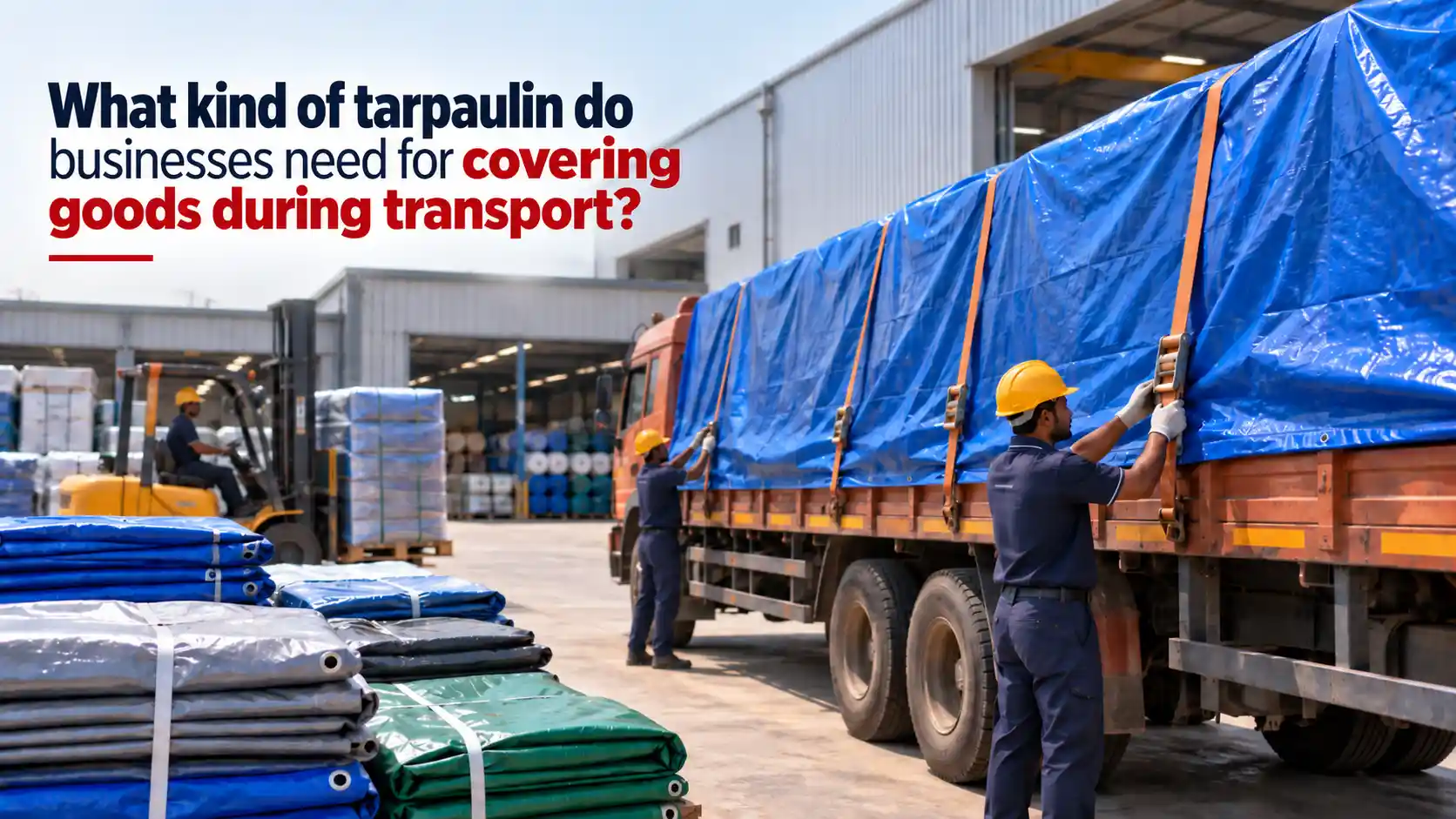
What kind of tarpaulin do businesses need for covering goods during transport?
Transporting goods by road exposes them to rain, dust, sunlight and repeated handling. The right cover can help protect the load throughout the journey, but businesses often face one simple question: what type of tarpaulin should we actually choose?
The answer depends on the goods, load size, journey length, weather conditions and how often the cover will be used. A Tarpaulin Manufacturer can help buyers match these factors with a suitable specification instead of choosing only by size or price.
For Ashoka Poly Laminators, the starting point is the application. A cover used for agricultural goods may have different requirements from one used for construction materials or industrial loads.
Start with the goods you need to cover
The product being transported should be the first consideration.
Agricultural materials, machinery, construction supplies and other bulk goods can have very different shapes and handling requirements. Some loads are compact and easy to cover, while others have uneven surfaces or exposed edges.
The weight of the goods also matters. A business moving heavy materials regularly may need to consider the expected handling conditions more carefully than someone covering a light load for occasional transport.
Ashoka Poly Laminators recommends looking at the actual load before deciding on the size and specification of the covering material.
Weather protection matters during the journey
A transportation cover may face several weather conditions during a single trip.
Rain can create moisture problems for exposed goods. Dust can settle on uncovered materials, while prolonged sunlight can increase exposure to UV radiation. Wind can also place additional stress on a cover that has not been secured properly.
This makes weather exposure an important part of the buying decision.
Double Kissan Tarpaulin by Ashoka Poly Laminators can be considered for transportation and outdoor covering applications. The suitable specification should still be selected according to the goods, usage conditions and expected exposure.
Choose a size that works with the load
Size is one of the easiest things to overlook.
A cover that is too small may leave sections of the load exposed. A very large cover, on the other hand, can create unnecessary folds and make securing more difficult.
Before ordering, businesses should measure the complete load rather than looking only at the vehicle’s dimensions.
Consider the:
- Length of the load
- Width of the load
- Height of the load
- Extra material needed around the sides
- Points where the cover will be secured
A suitable size makes everyday covering and removal much easier.
How often will the tarpaulin be used?
Occasional use and daily transportation are not the same.
A logistics company moving goods every day will repeatedly fold, unfold, secure and remove its covers. The material will also experience different weather conditions over time.
For regular operations, buyers should think about handling convenience as well as protection.
A Tarpaulin Manufacturer can discuss the intended frequency of use and help buyers understand which specifications are appropriate for their particular application.
The goal is to choose a cover that fits naturally into the loading and unloading process.
Consider how the cover will be secured
Even a suitable tarpaulin needs proper securing.
During transportation, wind can pull against exposed sections. Movement of the vehicle can also cause the cover to shift if it has not been fastened correctly.
Businesses should therefore consider how the cover will be tied to the vehicle and load.
The size, fastening points and securing method should work together. Workers should also be able to secure and remove the cover without unnecessary difficulty.
This is especially important for businesses where loading and dispatch happen several times each day.
What if the load has sharp or uneven edges?
Some goods are more difficult to cover than others.
Construction materials, machinery components and irregularly shaped products may have corners or edges that can place additional stress on the covering material.
In these situations, the load should be arranged carefully before covering. Exposed sharp areas may also need suitable protection so they do not create unnecessary pressure points.
A tarpaulin is part of the protection system, but proper loading and securing practices remain equally important.
Transportation may not be the only use
Some businesses use the same cover after the vehicle reaches its destination.
For example, goods may remain temporarily outdoors before they are moved into a warehouse or processed further. In this situation, the cover needs to handle a longer period of exposure.
The buyer should therefore tell the Tarpaulin Manufacturer whether the product will be used only during transportation or also for temporary outdoor storage.
This simple detail can help ensure that the specification is selected according to the actual use.
A simple example for transport businesses
Consider a distributor transporting agricultural materials over a long-distance route.
The goods may leave the warehouse in dry weather but encounter rain several hours later. The load may also be unloaded and covered again at another location.
The business therefore needs to think about more than just the size of the vehicle. The cover must be suitable for the load, practical to secure and appropriate for the expected outdoor exposure.
If the same cover is used repeatedly, handling becomes an important part of the decision too.
APL Products can be considered within this application-based approach, where the focus remains on how the product will actually be used.
What should buyers tell their supplier?
A supplier can provide more useful guidance when the buyer gives clear information.
Before placing an order, businesses should be ready to discuss:
Type of goods: What exactly will be covered?
Load dimensions: What are the length, width and height?
Transport conditions: How far will the goods travel?
Usage frequency: Is the cover used occasionally or every day?
Weather exposure: Will it face rain, sunlight, dust or wind?
Storage use: Will the same cover be used after transportation?
These answers create a much clearer starting point for selecting the right product.
Why Ashoka Poly Laminators?
The right tarpaulin should be selected according to its intended use rather than a single specification such as thickness or price.
Ashoka Poly Laminators can help businesses review their requirements for transportation and outdoor covering applications.
The discussion can focus on load dimensions, weather exposure, handling frequency and securing methods. This makes it easier to identify a suitable option without adding specifications that the application does not require.
For businesses transporting goods regularly, Ashoka Poly Laminators can also help turn everyday handling requirements into a more practical packaging-covering specification.
Make the choice around the journey
There is no universal tarpaulin specification for every type of transported load.
A business should first understand what it is covering, how large the load is, how far it will travel and what conditions the cover will face. Frequency of use and the method of securing the cover also deserve attention.
A Tarpaulin Manufacturer can then help buyers evaluate these requirements and select an appropriate covering solution.
The most useful approach is simple: choose the tarpaulin around the journey, not just the product catalogue.
If you need help selecting tarpaulin for transportation or outdoor covering, contact Ashoka Poly Laminators.
Phone: +91 7078666249
Email: apl@ashokafoam.com

Recent Posts
What packaging materials do you need when your products require different pack sizes?

What information does a pouch manufacturer need before production starts?