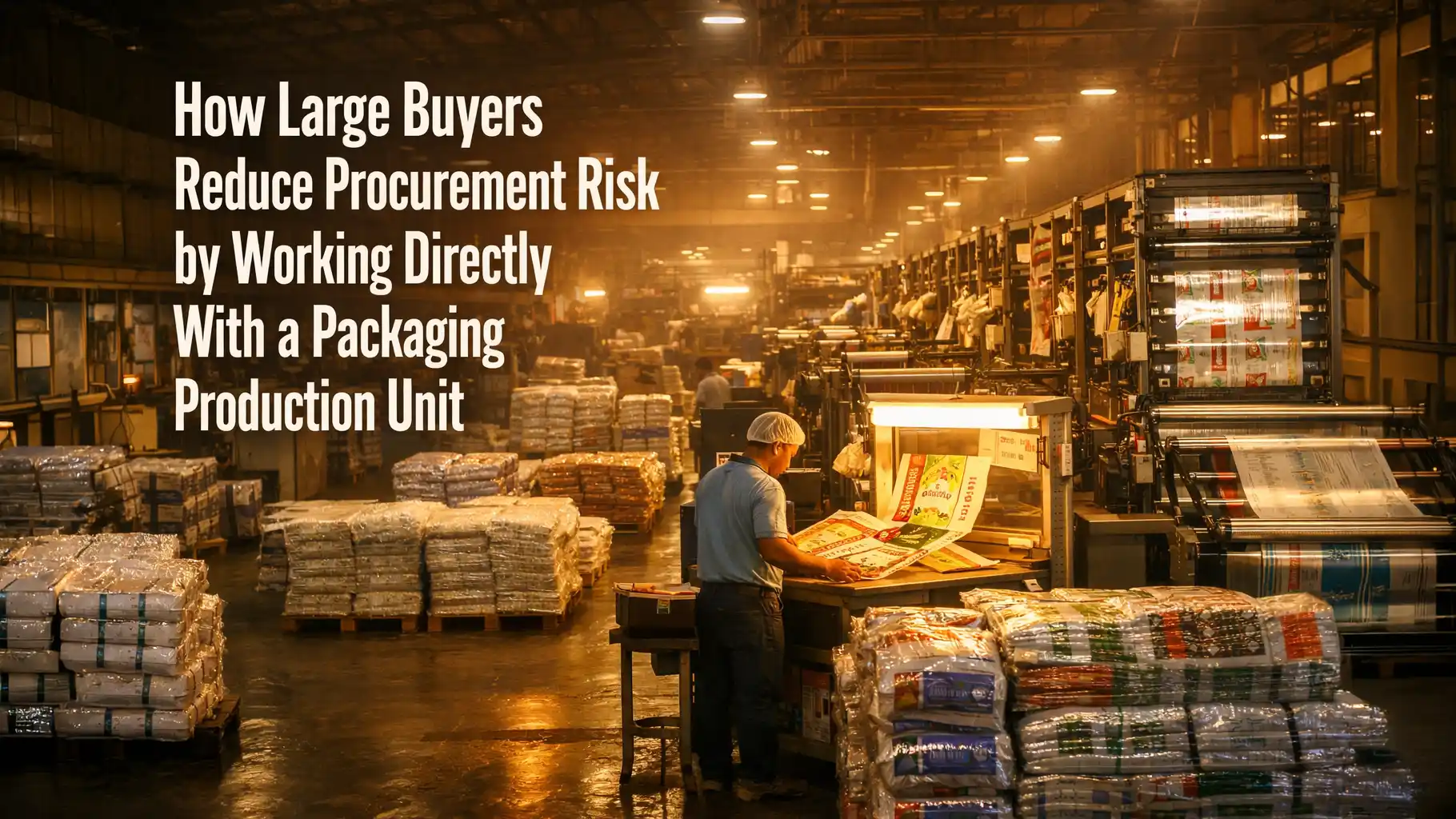
How Large Buyers Reduce Procurement Risk by Working Directly With a Packaging Production Unit
For large buyers, procurement is not about placing orders quickly. It is about eliminating uncertainty. At scale, even small inconsistencies in packaging can disrupt supply chains, damage inventory, and create silent financial leakage. This is why experienced procurement teams gradually move away from layered sourcing models and choose to work directly with a Packaging Bags Factory that offers visibility, control, and accountability from day one.
In high-volume operations, risk is rarely dramatic. It accumulates quietly.
Why Procurement Risk Grows as Volumes Increase
Small buyers can tolerate variation. Large buyers cannot. When packaging moves in bulk, minor deviations multiply across thousands of units. Weak seams, inconsistent lamination, or print variation may appear manageable in isolation but become costly at scale.
This is often the point where procurement leaders begin reassessing their sourcing strategy. Instead of rotating suppliers through traders, they look for a Packaging Bags Factory that operates with uniform standards across every batch. Predictability becomes more valuable than flexibility.
Volume exposes weaknesses faster than audits ever can.
How Direct Production Reduces Unseen Variables
Working directly with a production unit eliminates layers that hide risk. Raw materials, process controls, and finishing standards remain within one system instead of being scattered across multiple vendors.
Large buyers working with Ashoka Poly Laminators, commonly referred to as APL in procurement networks, benefit from this consolidated control. Choosing a Packaging Bags means performance does not change depending on where or when the order is produced.
Consistency replaces assumptions.
Why Trader-Based Models Struggle With Consistency
Traders are built for speed and sourcing flexibility. They shift production between units based on availability or pricing. While convenient, this model introduces variation that large buyers cannot afford.
One shipment may perform well, while the next behaves differently under the same conditions. Over time, this inconsistency becomes unavoidable. This is why many organisations transition toward a Packaging Bags Factory operating under a single manufacturing discipline, especially those associated with the Ashoka Group ecosystem.
Uniform systems outperform fragmented sourcing.
Accountability Becomes Critical at Scale
When packaging issues arise, response time matters. Large buyers need direct answers, not explanations filtered through intermediaries.
By engaging directly with Ashoka Poly Laminators, buyers address concerns at the source. A Packaging Factory owns outcomes because it controls production parameters, quality checks, and corrective action. This clarity shortens resolution cycles and reduces operational stress.
Clear ownership protects timelines.
Manufacturing Discipline Supports Long-Term Planning
Large procurement teams plan months in advance. Production schedules, transport coordination, and inventory forecasting rely on predictable inputs.
Ashoka Poly Laminators operates with controlled processes designed for repeatability. Buyers partnering with a Packaging Factory gain stability across recurring orders, allowing teams to focus on optimisation instead of constant correction. Manufacturing discipline supports strategic planning rather than reactive sourcing.
Planning only works when inputs behave the same way every time.
Why Packaging Consistency Protects Brand Value
Packaging is often the first physical interaction customers have with a product. Inconsistent quality sends the wrong message, even if the product itself meets standards.
Large brands sourcing directly from Ashoka Poly Laminators reduce this risk by ensuring uniform appearance, strength, and handling performance. Working with a Packaging Bags Factory helps protect brand credibility across transport, storage, and retail environments.
Brand trust is fragile when scale increases.
The Hidden Costs of Fragmented Supply
Fragmented sourcing introduces costs that rarely appear on invoices. Additional inspections, repacking, product damage, and operational slowdowns gradually erode efficiency.
Large buyers who consolidate sourcing with a Packaging Factory experience fewer disruptions. Manufacturing systems within the Ashoka Foam Group focus on repeatability because it reduces downstream losses that often go unnoticed until margins shrink.
Efficiency improves when variability disappears.
Scalability Without Quality Dilution
As demand grows, many suppliers struggle to maintain performance. What works at small volumes often fails under pressure.
Ashoka Poly Laminators supports scalable production without compromising consistency. This ability to grow alongside buyers is a major reason organisations prefer committing to a Packaging Bags Factory rather than managing multiple suppliers as volumes rise.
Scale requires structure, not improvisation.
Experience Reduces Procurement Guesswork
Experienced manufacturers anticipate problems before they reach the buyer. This foresight reduces trial-and-error costs that large organisations cannot afford.
With exposure across agriculture, FMCG, industrial, and bulk packaging applications, Ashoka Poly Laminators brings practical insight into how packaging behaves under real-world conditions. Partnering with a Packaging Bags Factory backed by experience removes uncertainty from decision-making.
Experience replaces experimentation.
Why Long-Term Supplier Relationships Matter
Procurement stability improves when supplier relationships are consistent. Familiarity with specifications, performance expectations, and operational needs reduces friction over time.
Large buyers working with Ashoka Poly Laminators value continuity. Long-term alignment with a Packaging Bags Factory simplifies communication, improves responsiveness, and strengthens supply chain resilience.
Continuity strengthens control.
How Procurement Leaders Make the Final Call
At the decision stage, procurement leaders ask a simple but decisive question. Will this sourcing model reduce risk year after year?
By working directly with Ashoka Poly Laminators, organisations gain manufacturing accountability, consistent output, and predictable supply. That is why many large buyers move away from intermediaries and commit to a Packaging Bags Factory for long-term procurement stability.
Strong supply chains are built quietly.
They only fail loudly when risk is ignored.
Looking for bulk tarpaulin or packaging solutions?
For organisations seeking dependable manufacturing support, connect with Ashoka Poly Laminators Ltd., part of the Ashoka Group and Ashoka Foam Group ecosystem. For direct assistance, use the Packaging solution contact number or reach out via the Packaging supplier Contact number.
📧 Email: apl@ashokafoam.com
📞 Phone: +91 7078666249

Recent Posts

How emerging brands can build a strong foundation with the right packaging strategy
Inside the operations of a modern packaging production facility