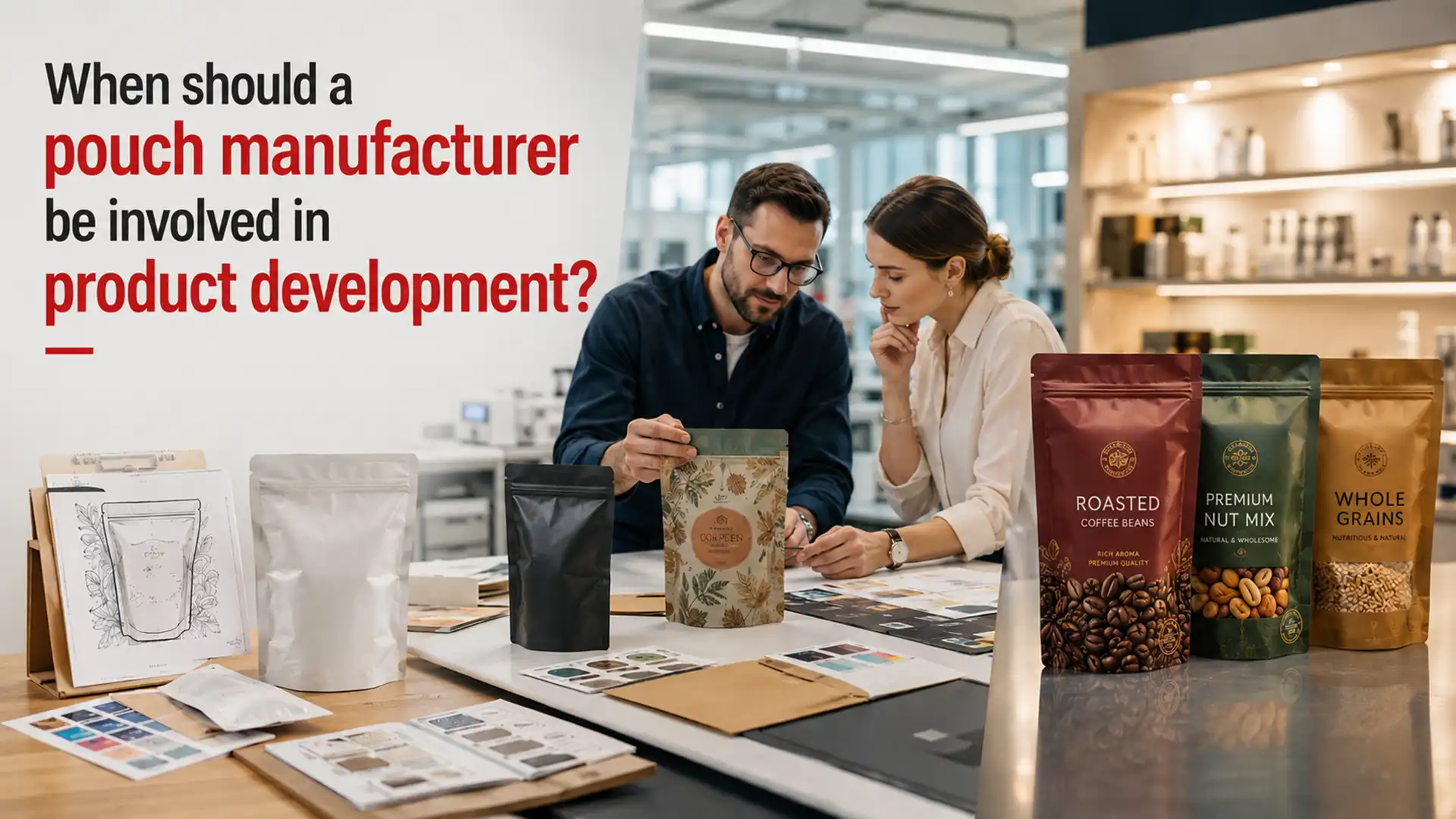
When should a pouch manufacturer be involved in product development?
Packaging decisions are often postponed until a product is almost ready for launch. That can work for straightforward products, but it becomes risky when the package has to meet specific protection, filling, sealing, or presentation requirements.
The better time to involve a pouch manufacturer is when the product’s basic requirements are becoming clear, but there is still enough flexibility to adjust the packaging format. At Ashoka Poly Laminators, this stage allows packaging requirements to be considered alongside the product rather than being treated as a final production task.
For businesses developing Laminated Pouches, early discussion can help connect the product, packaging structure, filling process, printing, and distribution requirements before those decisions become difficult to change.
When the product characteristics are known
A packaging manufacturer does not need to be involved when the product exists only as an idea.
However, once the business understands what the product is, how much will go into each pack, and what conditions it will encounter, packaging discussions become much more productive.
A food powder, snack, spice, or dry ingredient may have very different packaging requirements. Moisture sensitivity, oxygen exposure, aroma retention, product weight, and expected shelf life can all influence the structure that is appropriate.
Ashoka Poly Laminators can use these details to understand what the packaging needs to accomplish before a final format is selected.
The filling process should influence the pouch
The packaging line is an important part of product development.
A pouch that looks perfect as a sample may not behave the same way when it reaches a filling machine. Dimensions, opening characteristics, seal areas, and material behaviour can all influence how efficiently the package moves through production.
This is particularly relevant when a company is moving from manual or small-batch filling to automated production.
Discussing the filling process early gives the manufacturer an opportunity to consider how the pouch needs to behave during actual production. Ashoka Poly Laminators can factor these operational requirements into packaging discussions instead of treating the finished artwork as the starting point.
Material selection should follow the product
One of the advantages of laminated structures is that different layers can contribute different properties.
A product requiring stronger moisture protection may need a different structure from one where oxygen or light exposure is the greater concern. Physical handling requirements can introduce another consideration.
The objective is not to add as many layers as possible. It is to select a structure that makes sense for the product and its expected journey.
For laminated pouches, this means understanding the contents, storage period, transportation conditions, filling process, and intended use before finalising the material combination.
Do not finalise artwork before understanding the pouch
Packaging artwork is often developed well before the physical pouch is completely defined.
That can create unnecessary revisions.
Changes to pouch dimensions, seal positions, gussets, openings, or other construction details can affect where logos, product information, images, and other design elements should appear.
Developing the physical format and artwork together can make the process more efficient.
At Ashoka Poly Laminators, the printed surface is considered alongside the pouch construction so that visual presentation and physical requirements can be developed as parts of the same Packaging Solution.
Product protection needs to be considered before launch
A package does more than contain the product.
It may need to help protect the contents from moisture, oxygen, light, contamination, or physical handling during the period between manufacturing and consumption.
The importance of each factor depends on the product.
For example, a moisture-sensitive powdered product may need a different approach from a dry snack where aroma retention and physical protection are more important. The distribution route can introduce additional considerations.
Discussing these requirements with a manufacturer before launch gives the product team more opportunity to evaluate whether the planned structure is suitable.
Storage can change the packaging requirement
A product may spend only a few days in transportation but several weeks in storage.
During that period, the packaging can encounter changing temperature, humidity, stacking pressure, and handling conditions. A specification that works for short-term storage may not necessarily be ideal for a longer distribution cycle.
This is why packaging development should consider the entire journey.
Ashoka Poly Laminators can work with customers to understand where the product will be stored and how it will move through the supply chain. That information helps connect the packaging structure with real operating conditions.
A pouch also has a commercial job
Technical performance is essential, but packaging is also part of the product’s presentation.
The pouch may be the first physical representation of a new product that a customer encounters. Brand identity, product information, imagery, typography, and colour treatment all contribute to how that product is perceived.
The challenge is making the visual design work without compromising the technical requirements.
With laminated pouches, the printable outer surface gives brands considerable scope for product communication. Involving the manufacturer while the format is being developed can help ensure that artwork works with the actual dimensions and construction of the finished package.
Testing should happen before everything is locked
A packaging sample should be evaluated in conditions that resemble actual production and use whenever practical.
Instead of looking only at an empty pouch, businesses can consider how it behaves when filled, sealed, stacked, transported, and handled.
These trials can reveal issues that are difficult to identify from artwork or an empty prototype.
For a new product launch, discovering a packaging problem during early testing is considerably more useful than discovering it after large-scale production has begun.
This is another reason Ashoka Poly Laminators sees manufacturer involvement as something that can add value during development rather than only at the purchasing stage.
Consider a new snack entering the market
Imagine a company preparing to launch a new snack in several pack sizes.
The product team has already established the recipe and approximate serving size. Marketing is developing the brand identity, while operations are assessing filling equipment and distribution.
This is an ideal point for packaging discussions.
The manufacturer can understand the product characteristics, proposed pack sizes, filling method, storage period, transportation route, printing requirements, and expected volumes. Those inputs can then inform the packaging specification.
Instead of designing the pouch after everything else has been finalised, the package becomes part of the product development process.
When is the right moment to involve the manufacturer?
There is no universal calendar date.
The practical answer is: bring the manufacturer in once enough product information is available to discuss packaging requirements, but before the physical format, filling process, and artwork are completely locked.
That window provides room to evaluate alternatives and make changes without disrupting an established production system.
For businesses developing laminated pouches, this can be especially valuable when launching a new product, changing pack sizes, moving to automated filling, or entering a new distribution channel.
Final thoughts
A pouch manufacturer does not need to be involved from the first product idea. But waiting until the final artwork and production specifications are already fixed can unnecessarily limit the available options.
Early collaboration gives the product team an opportunity to consider material structure, product protection, filling, sealing, storage, transportation, and visual presentation together.
Ashoka Poly Laminators works with businesses at this development stage to understand the product and its packaging requirements before the final specification is established. For companies planning laminated pouches, involving the manufacturer early can make packaging development more practical, reduce avoidable revisions, and create a package that is better aligned with the product’s complete journey.
Contact
If you are developing a new product or reconsidering an existing pouch format, share your product type, pack size, filling process, printing requirements, and expected distribution conditions with Ashoka Poly Laminators.
Phone: +91 7078666249
Email: apl@ashokafoam.com
Discuss your packaging requirements and request a customised quotation.

Recent Posts

Festive dispatches are growing—can your tarpaulin handle the journey?
Festive sweets need more than a pretty pouch—what keeps them protected?