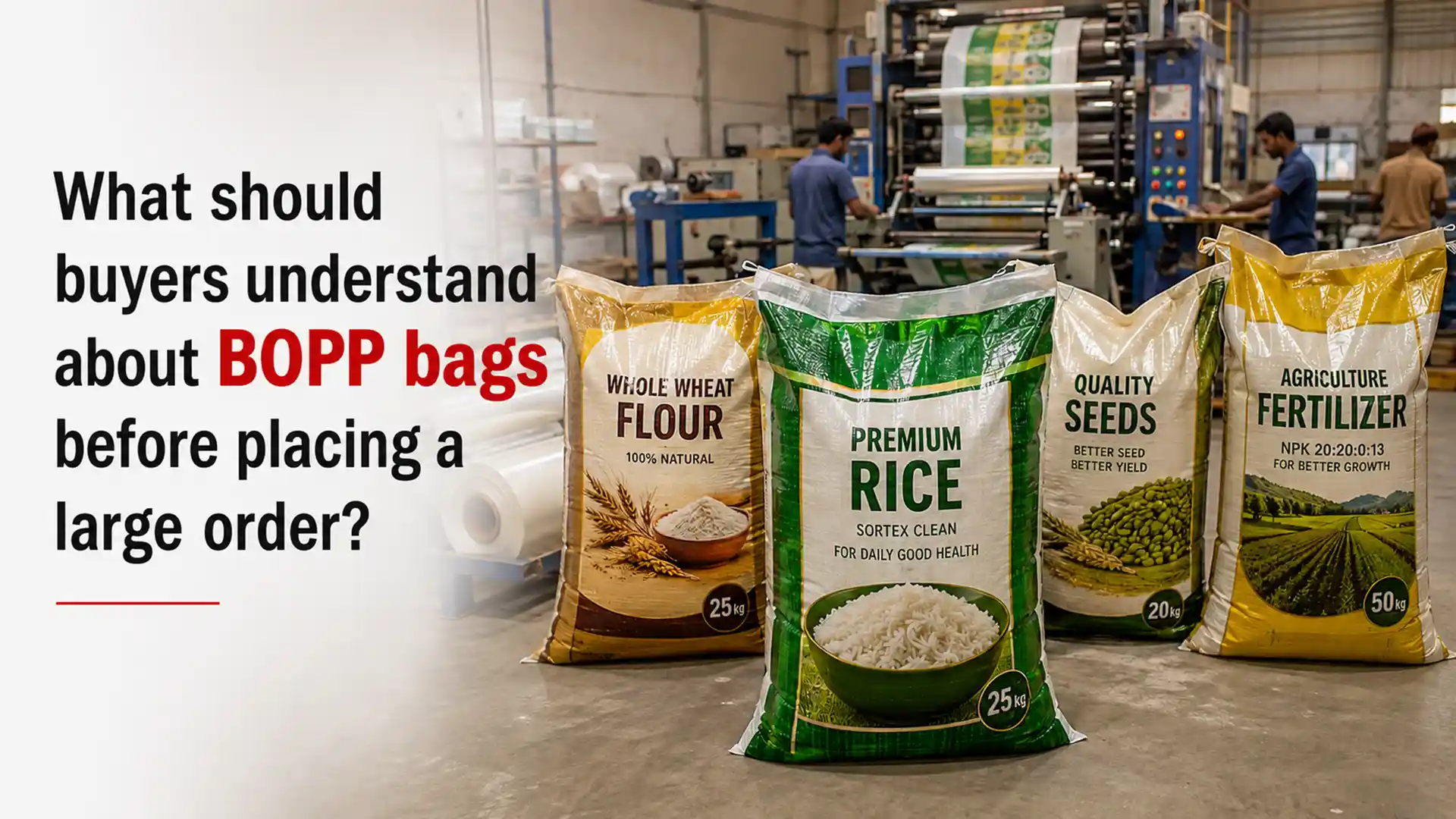
What should buyers understand about BOPP bags before placing a large order?
A large packaging order is rarely just a matter of deciding how many bags are required. Once production volumes increase, small specification differences can affect filling, stacking, transportation, storage, printing consistency, and overall handling. Getting those details right before production begins can prevent expensive changes later.
When working with a BOPP Bags Manufacturer, buyers should therefore discuss the complete application rather than simply requesting a standard bag. The product being packed, required weight, bag dimensions, filling process, printing, storage conditions, and distribution route all contribute to the final specification.
For businesses placing recurring or high-volume orders, a clear technical brief is often more valuable than choosing a bag based only on appearance or quoted price.
Begin with the product going inside
The first question should not be, “Which bag should we buy?”
It should be, “What does the bag need to carry?”
Rice, animal feed, seeds, fertiliser, and other bulk materials can place different demands on packaging. Product weight and characteristics influence the dimensions, construction, and handling requirements.
For example, a bag intended for a heavier load may need a different construction from one designed for lighter contents. The filling method can also influence the opening and overall format.
A good BOPP Bags Manufacturer should be able to understand these requirements before recommending a specification.
Size should match the filling operation
Bag dimensions are not simply a matter of how much material can fit inside.
The relationship between bag size and filling equipment can influence production efficiency. A bag that is too large, too narrow, or otherwise unsuitable for the filling process can create unnecessary adjustments on the production line.
Buyers should therefore provide information about the intended fill weight and filling method before finalising dimensions.
This becomes especially important for large orders because even a minor dimensional issue can affect thousands of bags.
Understand what the woven construction contributes
BOPP bags combine a woven base with a BOPP surface, creating a packaging format that can provide structural support along with a printable outer layer.
The woven construction is important for the physical demands placed on the filled bag. The finished format must be appropriate for lifting, stacking, transportation, and general handling.
Buyers should discuss how the bags will actually move through their supply chain instead of selecting a specification solely from a catalogue.
An experienced BOPP Bags Manufacturer can use those application details to help establish a more suitable construction.
Printing is not just about choosing a design
For many businesses, the printed surface is a major reason for selecting BOPP packaging.
The bag may need to display a brand name, product information, specifications, graphics, handling instructions, or other details. When large quantities are involved, consistency becomes particularly important.
A small variation may be difficult to notice on one sample but become obvious when thousands of bags are displayed together.
Before approving the artwork, buyers should confirm the required dimensions, print layout, colours, and important information that needs to remain clearly visible on the finished bag.
Ashoka Poly Laminators works with businesses to align printing requirements with the physical bag format rather than treating artwork as a completely separate process.
Think about what happens after filling
Once the bag is filled, its journey has only started.
It may be moved from the filling line to a warehouse, stacked with other bags, loaded onto a vehicle, transported over long distances, unloaded, and stored again before reaching the customer.
Each stage can introduce different handling conditions.
This is why buyers working with a BOPP Bags Manufacturer should explain their complete distribution process. A bag intended for short-distance movement may have different requirements from one that will spend considerable time in transportation and storage.
Large orders make consistency more important
A sample can tell you what a product looks like. A large production run tells you how consistently that specification can be reproduced.
When ordering in substantial quantities, buyers should pay attention to whether the approved construction, dimensions, printing, and finishing can be maintained throughout the production run.
Consistency matters because procurement teams generally expect the next batch to work with the same filling and handling processes as the previous one.
For recurring requirements, establishing a clear specification at the beginning can make future purchasing much easier.
Do not choose specifications simply because they sound stronger
“Heavy-duty” can sound reassuring, but it is not a complete specification.
The appropriate bag depends on the actual application. A business may need strength in one area while placing greater importance on print quality, dimensions, filling compatibility, or handling.
Choosing unnecessary material or construction features can also increase costs without providing meaningful benefits for the application.
A better approach is to define the operating conditions first and then determine which characteristics are genuinely required.
This is where discussions with a BOPP Bags Manufacturer can help turn a general packaging requirement into a practical specification.
Storage conditions deserve attention
Where the filled bags will be stored can influence purchasing decisions.
Warehouse storage, outdoor exposure, humidity, stacking arrangements, and storage duration can all change the conditions experienced by the packaging.
A buyer should therefore communicate whether the bags will remain indoors, how they will be stacked, and approximately how long they may remain in storage.
This information gives the manufacturer a better understanding of the environment the packaging is expected to handle.
Ashoka Poly Laminators considers these practical application details when discussing BOPP woven packaging requirements with customers.
Ask about the complete order specification
Before approving a large production run, buyers should have a documented understanding of the important details.
These may include:
- Bag dimensions
- Required fill weight
- Construction requirements
- Printing artwork and specifications
- Stitching and finishing
- Filling method
- Expected order quantity
- Packaging and dispatch requirements
The purpose is not to create unnecessary paperwork. It is to make sure the buyer and manufacturer are working from the same specification.
For a large order, clarity at this stage can prevent confusion later.
Consider future orders before finalising the first one
A large order is often not a one-time purchase.
If the packaging will be reordered regularly, it makes sense to establish a specification that can be reproduced consistently. This is particularly useful for brands with established product ranges where packaging needs to remain visually and dimensionally consistent across batches.
A dependable BOPP Bags Manufacturer should be able to understand whether the requirement is a one-off order or part of a longer-term packaging program.
That information can also help buyers plan quantities and future production more effectively.
A practical example: bulk rice packaging
Consider a rice brand preparing to order several thousand bags.
The procurement team knows the required fill weight and has approved the artwork. But before production begins, the team also needs to consider how the bags will be filled, stacked in the warehouse, transported to distributors, and displayed in the market.
If those details are discussed only after production begins, changes can become difficult.
If they are addressed during specification development, the packaging can be designed around the complete journey from filling line to distribution.
This is the type of application-focused discussion Ashoka Poly Laminators can have with buyers before a large BOPP bag order is finalised.
What should buyers ask before giving approval?
A useful final discussion with the manufacturer can cover a few essential questions:
Does the bag specification match the actual product weight and filling process?
Are the dimensions suitable for the intended equipment and handling method?
Has the artwork been checked against the final bag format?
Will the packaging face demanding storage or transportation conditions?
Can the agreed specification be maintained for future orders?
These questions help move the conversation away from simply comparing quotations and toward evaluating the complete packaging requirement.
Final thoughts
A large BOPP bag order should be treated as a specification decision, not simply a purchasing transaction. Product characteristics, dimensions, construction, printing, filling, storage, transportation, and repeat-order requirements all deserve attention before production begins.
Working with an experienced BOPP Bags Manufacturer can help buyers connect these factors and develop packaging that fits the actual application. Ashoka Poly Laminators works with businesses on BOPP Woven Packaging requirements by considering the product, manufacturing specifications, printing needs, and expected handling conditions together.
If you are preparing a bulk order, providing these details before requesting final production approval can make the process clearer and reduce avoidable changes later.
Contact Ashoka Poly Laminators
For bulk BOPP bag requirements, customised specifications, printing requirements, or repeat production needs, contact Ashoka Poly Laminators.
Phone: +91 7078666249
Email: apl@ashokafoam.com

Recent Posts
Festive dispatches are growing—can your tarpaulin handle the journey?
Festive sweets need more than a pretty pouch—what keeps them protected?