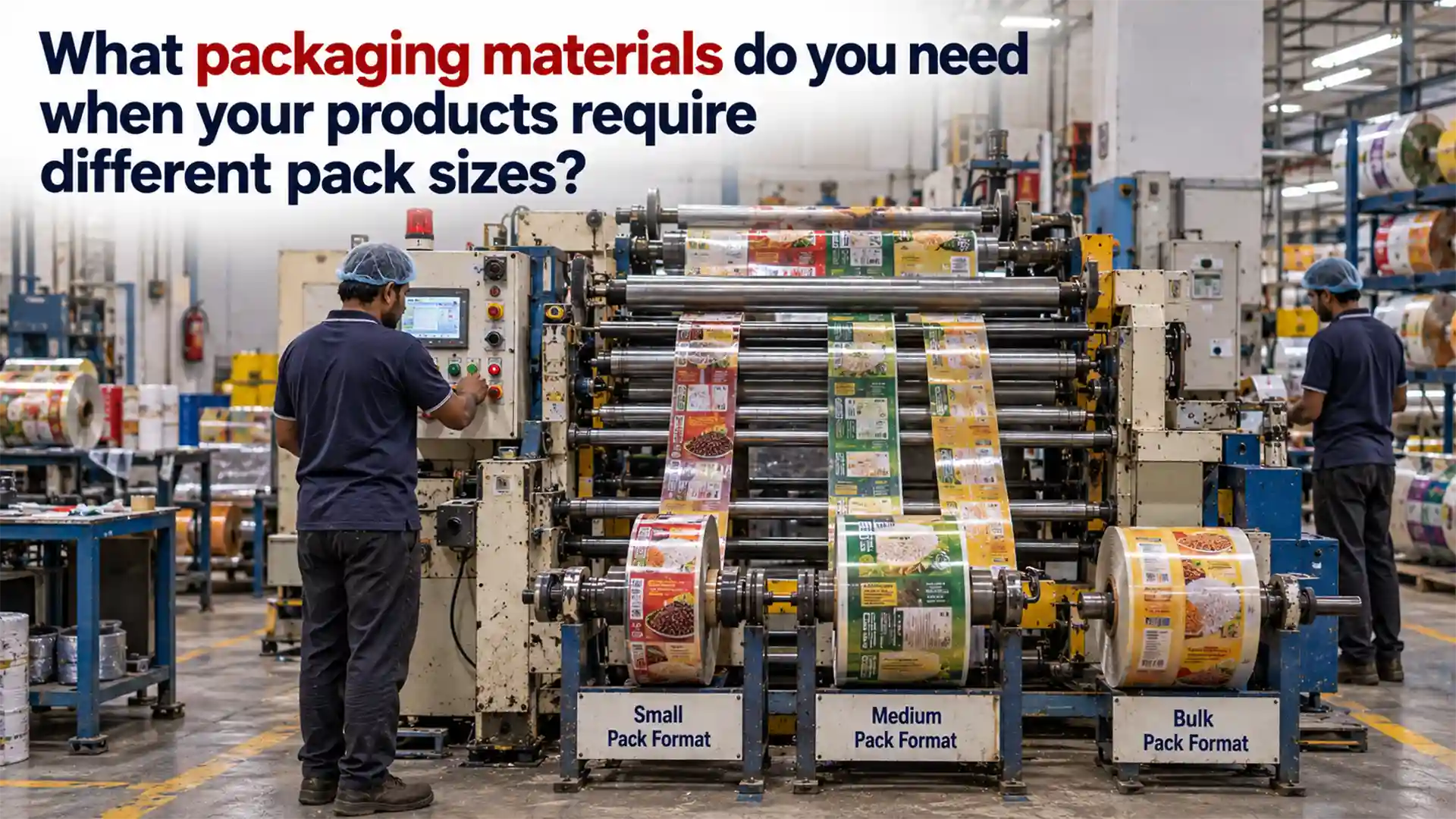
What packaging materials do you need when your products require different pack sizes?
When a product is sold in different quantities, using one packaging format for every size can create practical problems. The package may become too large for smaller quantities or too tight for larger ones. Choosing the right Packaging Material Supplier can help businesses plan suitable bags, pouches and flexible packaging formats for different pack sizes without making the packaging system unnecessarily complicated.
At Ashoka Poly Laminators, packaging requirements are considered around the product, quantity, filling process and final use. The aim is to create a packaging range that works across different sizes while keeping production and handling practical.
Start with the product and pack quantity
The first step is to understand what is being packed and how much goes into each pack.
A business selling the same product in 100 g, 500 g and 1 kg quantities may need different pouch or bag dimensions. The material structure may remain similar, but the size and construction can change according to the quantity.
This is why a Packaging Material Supplier should know the complete size range before production begins. Planning all required formats together can make the packaging system easier to manage.
For Ashoka Poly Laminators, the quantity is only one part of the discussion. The product characteristics and filling method also help determine a practical format.
Different sizes do not always need completely different materials
Businesses sometimes assume that every pack size needs a completely different packaging material.
That is not always the case.
If the product and packaging requirements remain similar, the same general material approach may work across several sizes. What changes may simply be the pouch dimensions, bag size or amount of material used.
A Packaging Material Supplier can help identify where standardization is possible. This can reduce unnecessary variation while still allowing the business to offer different quantities.
The right balance is to create enough flexibility without making the packaging range difficult to manage.
Consider how each size will be filled
Pack size and filling equipment are closely connected.
A small pouch may move differently through a filling line than a larger format. The opening, dimensions and sealing area may also need to suit the machinery being used.
For businesses using automated equipment, this becomes particularly important. A packaging format that looks suitable on paper may still create problems if its dimensions do not work smoothly with the filling process.
Ashoka Poly Laminators can discuss these practical requirements before a new size is finalized. This helps businesses avoid designing a package first and discovering production issues later.
Think about storage and handling
Different pack sizes can behave differently in warehouses.
Smaller packs may be easier to arrange in cartons, while larger packs may require more space and different stacking arrangements. The final packaging should therefore be considered as part of the complete storage process.
A Packaging Material Supplier can help businesses look beyond the individual package and consider how different sizes will be stored, moved and transported.
For example, a food manufacturer offering several pack sizes may need the smaller formats for retail shelves and larger formats for distributors. Each size serves a different part of the supply chain.
Flexible packaging can make size changes easier
Flexible packaging is useful when businesses need several product quantities.
Pouches and laminated formats can be developed in different dimensions while maintaining a consistent product identity. This allows businesses to create a recognizable packaging family across multiple sizes.
APL Flexible Packaging can be considered when a business needs packaging that combines different formats with a consistent visual approach.
The important point is that size changes should be planned around actual product requirements rather than simply scaling the dimensions up or down.
Printing should work across the whole range
Packaging design can become complicated when a product has many sizes.
The artwork needs to remain readable on each format. Important information should not become too small on compact packs, while larger packs should not have excessive empty areas.
Businesses should therefore prepare artwork with the complete packaging range in mind.
Ashoka Poly Laminators can work with businesses to consider how printed information fits different pouch or bag dimensions. Consistency across the range can make products easier for customers to recognize.
Avoid creating too many packaging variations
More sizes can give customers greater choice, but too many packaging specifications can create operational challenges.
Every additional format may require separate artwork, production planning, inventory management and purchasing.
A Packaging Material Supplier can help businesses consider whether each proposed size serves a genuine customer or distribution requirement.
For example, if two pack sizes are used for nearly the same purpose, the business may want to review whether both are necessary. Simplifying the range where practical can make packaging management easier.
A simple example from packaged food
Consider a snack manufacturer that sells the same product in three quantities.
The smallest pack is intended for individual customers. A medium pack is used by families, while a larger format is supplied through distributors.
Although all three contain the same product, their packaging needs are not identical. The dimensions, handling requirements and amount of packaging material can change with the quantity.
APL Packaging Products can be planned around these differences while maintaining a consistent product presentation.
This approach gives each pack size a clear purpose instead of treating every format as simply a larger or smaller version of another.
What should buyers discuss before ordering?
A Packaging Material Supplier can provide better guidance when the buyer has a clear packaging brief.
Before requesting a quotation or sample, businesses should prepare information about:
- Product type
- Pack quantities
- Required dimensions
- Filling method
- Sealing process
- Expected order volume
- Printing requirements
- Storage conditions
- Transportation requirements
- Number of product variants
Having this information ready can make the development process faster and reduce unnecessary changes.
Ashoka Poly Laminators recommends discussing the complete packaging range at the planning stage, particularly when several sizes are expected to be produced regularly.
How can businesses keep packaging simple?
The easiest packaging system is not always the one with the fewest sizes. It is the one where every format has a clear purpose.
A Packaging Material Supplier can help businesses review whether different sizes are genuinely required and whether some material structures can be shared across the range.
This can be especially useful for growing businesses that are adding new pack quantities over time. Planning early can prevent packaging inventory from becoming unnecessarily complicated.
For businesses working with multiple products, APL Packaging Solutions can also support a broader approach to bags, pouches and flexible formats.
Why Ashoka Poly Laminators?
Choosing packaging for multiple pack sizes requires more than selecting different dimensions.
The product, quantity, filling process, printing requirements, storage conditions and distribution method all need to work together.
Ashoka Poly Laminators focuses on these practical factors when discussing packaging requirements with businesses. Instead of treating every size as an independent project, the complete packaging range can be considered from the beginning.
This can help businesses create packaging that is easier to produce, fill, store and handle.
Build a packaging range that works together
When products are available in different quantities, packaging should be planned as a connected range.
A Packaging Material Supplier can help businesses decide where standardization makes sense and where a different format is genuinely needed. This approach can make packaging easier to manage while still giving customers suitable pack choices.
The best starting point is simple: understand the product, define the required quantities and identify how each size will be filled, stored and transported.
For businesses developing or expanding their packaging range, Ashoka Poly Laminators can discuss suitable bags, pouches and flexible packaging requirements.
Need packaging for multiple product sizes? Contact Ashoka Poly Laminators for your requirement.
Phone: +91 7078666249
Email:apl@ashokafoam.com

Recent Posts
What packaging materials do you need when your products require different pack sizes?
What information does a pouch manufacturer need before production starts?