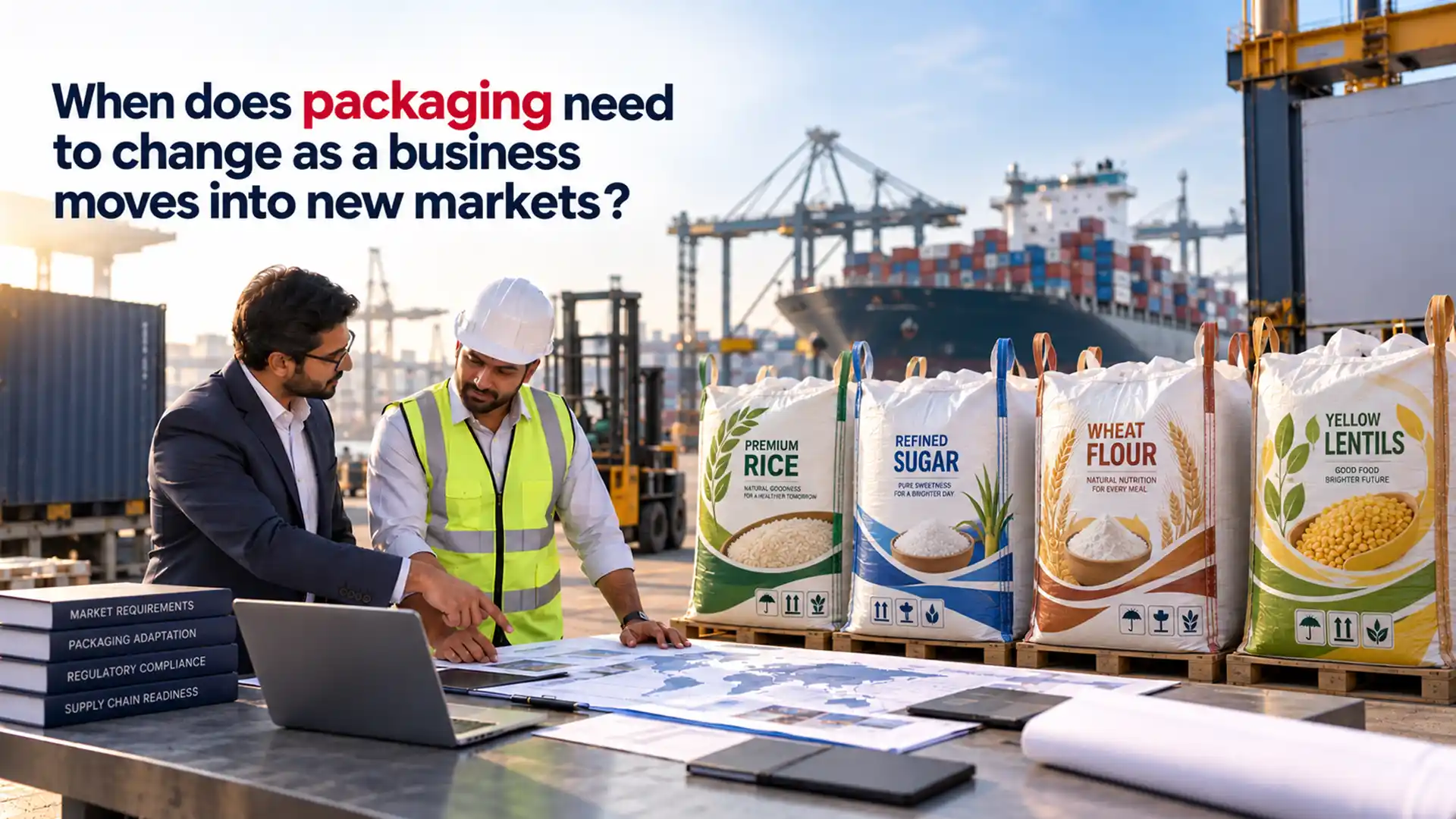
When does packaging need to change as a business moves into new markets?
Entering a new market can change the way a product needs to be packaged, even when the product itself remains unchanged. Longer transportation routes, different storage conditions, new customer expectations, additional handling points and different pack sizes can all create new requirements. A Packaging Manufacturer can help businesses review these factors before expanding production for a new market.
For Ashoka Poly Laminators, packaging decisions begin with the product and its journey. The objective is not to change a package simply because a business is entering a new region. Instead, the focus is on identifying whether the new market creates a genuine requirement for different dimensions, materials, printing or construction.
When should an existing package be reviewed?
A package that works well in an established market may continue to perform effectively in another market. However, businesses should review it whenever the conditions surrounding the product change significantly.
A longer supply route is one example. Products may spend more time in transit, pass through additional warehouses or experience more loading and unloading. A format designed for short-distance distribution may therefore need closer evaluation.
Ashoka Poly Laminators approaches this type of review by looking at the complete movement of the packed product rather than considering the package only at the point of filling.
The review should identify what has actually changed and whether the existing specification can accommodate those changes.
Transportation can change packaging requirements
Transportation is often one of the first factors to consider during market expansion.
A product supplied within a nearby region may move through a relatively short distribution chain. When the same product reaches distant customers, the number of handling stages can increase.
Bags and pouches may be loaded, unloaded, stacked and moved several times before reaching their destination. The packaging therefore needs to remain practical throughout this process.
Businesses should examine transportation distance, loading methods, stacking arrangements and expected handling frequency. These details can help determine whether modifications are necessary.
APL Industrial Packaging can be considered when packaging requirements are closely connected to bulk movement, warehouse operations and distribution processes.
New markets may require different pack sizes
Market expansion can also change the quantity in which a product is sold.
A business might traditionally sell a product in a large pack to distributors but discover that a new market has demand for smaller quantities. Another market may have institutional buyers who require larger formats.
Changing the fill quantity affects more than the printed number on the package. Dimensions, sealing space, filling equipment and storage arrangements may also need adjustment.
APL Packaging Products can be evaluated according to these differences, allowing businesses to consider packaging formats around actual product quantities instead of using one specification for every market.
Customer expectations can influence presentation
Packaging also communicates information about the product.
When entering a new market, businesses may need clearer product identification, updated artwork, additional information or a different visual presentation. This can become particularly important when several product variants are distributed through the same network.
However, artwork should not be developed independently from the physical packaging.
The available printing area, dimensions, sealing zones and production process all need to be considered. A practical packaging design should make product information clear without creating unnecessary production complications.
Ashoka Poly Laminators can support this type of packaging review by considering presentation requirements alongside the physical format.
Storage conditions deserve attention
A change in market can also mean a change in storage conditions.
Products may move from controlled warehouses into facilities where temperature, humidity, exposure or storage duration differs. The package should therefore be assessed according to the environment in which it will actually be stored.
Businesses should ask:
- How long will the product remain in storage?
- Will filled packages be stacked?
- How will they be moved inside the warehouse?
- Are storage conditions significantly different?
- Will the package experience additional handling?
These questions can reveal whether the existing packaging remains suitable or requires modification.
APL Packaging Materials can be considered as part of this assessment, with material selection linked to the product and its expected environment.
Not every market entry requires a complete redesign
One important point is that market expansion does not automatically mean starting from scratch.
If the product, distribution conditions and customer requirements remain similar, the existing package may continue to work. A smaller adjustment could be enough.
For example, a business might retain the same material structure while changing dimensions or artwork. Another may keep the same design but introduce a different pack size.
The decision should therefore be based on actual differences between the existing and new markets.
A Packaging Manufacturer should ideally help identify which changes are necessary and which can be avoided.
When does customization become useful?
Customization becomes more relevant when standard packaging creates repeated operational compromises.
A business may need a different format when:
The product quantity changes: New pack sizes may require different dimensions.
The distribution route becomes longer: Additional transportation and handling can change requirements.
The customer base changes: Retail, institutional and industrial buyers may need different formats.
Storage conditions change: Longer storage or different environments may require specification review.
Product variants increase: Multiple versions may benefit from differentiated packaging.
Existing packaging creates problems: Recurring filling, sealing, stacking or handling issues should not be ignored.
The purpose of customization should always be clear. A change should solve a real requirement rather than add unnecessary complexity.
A practical example of market expansion
Consider a food manufacturer that has traditionally supplied one region using a single pack format.
The business begins distributing the same product across several states. The product now travels farther, passes through additional warehouses and may remain in storage for longer periods.
The company also discovers that distributors in the new market prefer a different pack quantity.
Instead of immediately replacing the entire packaging system, the business can review the existing format against the new conditions. It may find that only dimensions and printed information need adjustment.
This application-based approach is one reason Ashoka Poly Laminators considers packaging requirements in relation to the actual supply chain.
Production planning should happen before launch
Packaging changes are easier to manage when they are identified before commercial production begins.
If a new market requires several additional formats, procurement teams need to understand the implications for raw materials, printing, production scheduling and inventory.
Too many packaging variations can create unnecessary complexity. Wherever practical, businesses should identify specifications that can be shared between markets.
APL Packaging Solutions can be evaluated around this balance between market-specific requirements and sensible standardization.
Production, procurement, marketing and logistics teams should ideally contribute to the packaging brief before the final specification is approved.
What should businesses provide to their supplier?
A detailed packaging brief can make the development process more efficient.
Businesses should communicate the product type, fill quantity, preferred dimensions, expected order volumes, distribution route, storage conditions and handling requirements.
If the product already has an established package, providing samples or existing specifications can also help the supplier understand what is changing.
For companies reviewing APL Flexible Packaging, information about filling equipment and sealing requirements can be particularly useful when new formats are being considered.
The clearer the requirements, the easier it becomes to distinguish necessary changes from optional ones.
Why Ashoka Poly Laminators?
Market expansion requires packaging decisions that connect product requirements with operational realities.
Ashoka Poly Laminators can be approached when businesses need to review bags, pouches or flexible packaging for a new market or distribution environment.
The focus should remain on practical requirements: product protection, suitable dimensions, production compatibility, handling, storage and presentation.
Rather than recommending unnecessary changes, the packaging discussion should establish what the new market actually demands and whether the existing format can meet those expectations.
Build packaging around the new market journey
A new market does not automatically mean a new package. The need for change depends on what is different about the product’s new journey.
Longer transportation, additional handling, new pack quantities, different storage conditions, customer expectations and market-specific information can all justify a review.
A Packaging Manufacturer can help businesses assess these factors before committing to a new specification. This makes packaging development more deliberate and reduces the risk of making changes without a clear operational reason.
For businesses preparing for expansion, Ashoka Poly Laminators can help turn the new market requirements into a practical packaging discussion.
Planning packaging for a new market? Contact Ashoka Poly Laminators.
Phone: +91 7078666249
Email:apl@ashokafoam.com

Recent Posts

When does packaging need to change as a business moves into new markets?
What role do flexible packaging materials play in product size changes?