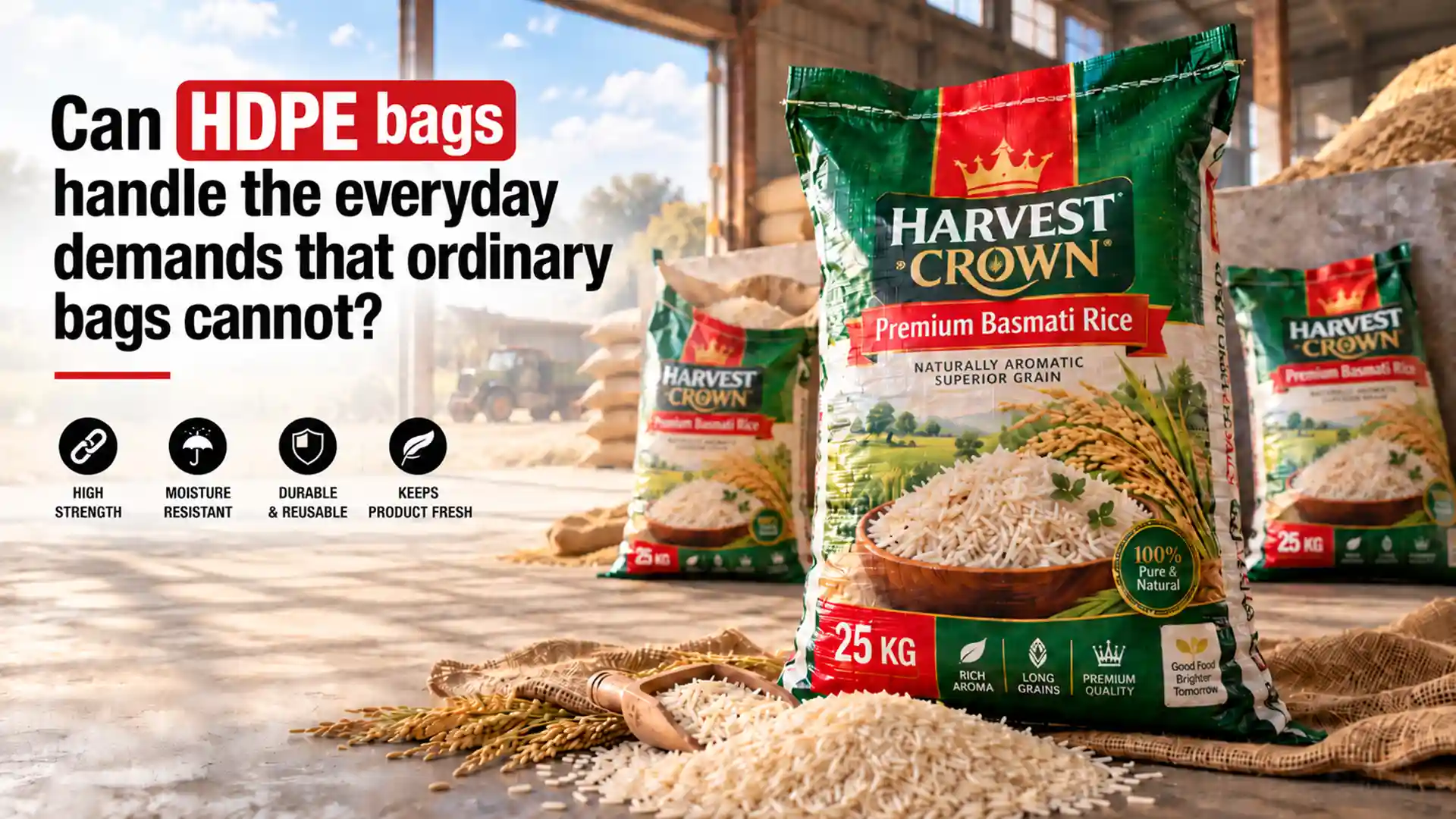
Can HDPE bags handle the everyday demands that ordinary bags cannot?
Not every product needs the same type of packaging. Some materials are heavy, some are handled repeatedly, and others may spend days or weeks in storage before reaching the customer. When ordinary bags start tearing, losing shape or becoming difficult to handle, it may be time to consider a more suitable packaging format. Ashoka Poly Laminators can be considered when evaluating HDPE Bag Manufacturers for packaging requirements where strength, handling and everyday use matter.
The important question is not whether HDPE bags are automatically better for every product. It is whether they suit the specific demands your product faces. Weight, filling method, storage, transportation and handling all play a role in that decision.
When packaging has to deal with heavy contents
A bag can look perfectly suitable when it is empty and still create problems once it is filled.
Heavy products put more pressure on the packaging during filling, lifting, stacking and transportation. If the bag is not suitable for the application, repeated handling can become a concern.
This is one reason businesses consider HDPE bags for products that need a practical packaging format capable of handling regular movement. Before choosing a bag, think about the actual weight of the product and how often it will be lifted.
The HDPE Bag Manufacturers you consider should be able to understand the application rather than looking only at the product name.
What happens when bags are handled every day?
Packaging rarely stays in one place after filling.
A filled bag may be moved from the production area to a warehouse, stacked with other bags, loaded onto a vehicle and handled again before reaching the customer. During this process, the packaging becomes part of the daily movement of the product.
If your bags are handled frequently, consider whether the selected format remains practical throughout this journey.
Ashoka Poly Laminators can be considered when you are looking at HDPE Bag Manufacturers for packaging that needs to fit into regular handling and distribution routines.
Product weight is only part of the decision
Two products with the same weight can still require different packaging.
A dense material may occupy less space, while a lighter product may require a larger bag. The physical form of the material can therefore influence the dimensions and overall format you need.
Think about both weight and volume before choosing a bag. Also consider whether the product is a powder, granule or another type of material.
This makes it easier to discuss your requirement with HDPE Bag Manufacturers and avoid selecting a format based only on weight.
When repeated stacking becomes important
Storage can put another type of demand on packaging.
Filled bags may be stacked for days or weeks before they are moved again. If your business stores large quantities, the shape and dimensions of the bags can influence how conveniently they can be arranged.
Consider the available warehouse space and how the filled bags are normally stacked. If they are moved regularly, think about how easy they are to pick up and rearrange.
APL Packaging Products can be considered when businesses need packaging that fits into broader storage and handling requirements.
What about transportation?
Transportation can expose packaging to repeated movement.
Bags may be loaded onto trucks, unloaded at warehouses and moved several times before reaching their final destination. The packaging therefore needs to work beyond the point where the product is filled.
If your goods travel long distances, think about how they are loaded, stacked and handled during transit.
When comparing HDPE Bag Manufacturers, explain the normal transportation conditions instead of focusing only on the price of an empty bag.
Ashoka Poly Laminators can be considered when the packaging requirement includes regular movement through a wider supply chain.
Do all products need the same bag construction?
No. The right packaging depends on the product and how it will be used.
A bag for a lightweight material may have different requirements from one carrying a heavier product. Similarly, packaging that remains indoors may have different needs from packaging that experiences frequent outdoor handling.
This is why it is better to start with the application rather than deciding on a bag specification first.
If you are reviewing HDPE Bag Manufacturers, explain what the product needs to withstand. The packaging discussion can then focus on the actual working conditions.
When ordinary packaging starts creating problems
You may already have an existing bag that works reasonably well but creates small problems during daily operations.
Perhaps the bag becomes difficult to handle after filling. Maybe the dimensions do not suit your storage arrangement, or the packaging does not fit your transportation process conveniently.
These problems may seem minor individually, but repeated every day, they can make packaging less practical.
Instead of immediately changing everything, identify the specific problem. Is it weight, size, handling, storage or transportation? Once the issue is clear, you can look for a more suitable packaging format.
Think about your filling process
The way a bag is filled can also affect how practical it is.
Manual filling and machine filling may have different requirements. If the bag needs to work with an existing filling process, its dimensions and opening should be considered alongside the equipment being used.
Before ordering, observe your current process. Where do workers face difficulty? Does the bag remain stable during filling? Is it easy to move after it is filled?
Ashoka Poly Laminators can discuss these practical requirements with businesses considering HDPE Bag Manufacturers for regular packaging use.
Printing can make the bag part of your product presentation
Packaging can also communicate important information about what is inside.
Depending on the application, you may need your brand name, product details, weight or other information printed on the bag. If several products are being packed, consistent presentation can also make the range easier to identify.
The printing requirement should be considered alongside the bag dimensions and intended use.
For businesses exploring APL Packaging Materials, this can be part of a wider discussion about creating packaging that is practical while also presenting the product clearly.
Can one bag work for every requirement?
This is where expectations should remain realistic.
A bag that works well for one product may not be the right choice for another. Even within the same business, different products may have different weights, volumes and handling conditions.
Instead of searching for one bag that can solve every packaging problem, identify the requirements that matter most for each product.
HDPE Bag Manufacturers can then be evaluated according to whether they can provide packaging that fits those specific applications.
Ashoka Poly Laminators can be considered when you need to review packaging requirements across different product types and quantities.
Look at the complete daily use
The value of packaging is not only visible when the product is first packed.
Think about everything that happens afterward: lifting, stacking, storage, loading, transportation, unloading and final handling. A suitable bag should make sense throughout this process.
APL Industrial Packaging can be considered as part of a broader approach where packaging is selected around the complete movement of goods rather than one stage alone.
For businesses comparing HDPE Bag Manufacturers, this application-based approach can make the decision more useful than simply comparing quotations.
Why Ashoka Poly Laminators can be considered
A packaging decision should begin with the product and the problems you experience during everyday use.
Ashoka Poly Laminators can be considered when you need to discuss HDPE Bag requirements around product weight, dimensions, filling, storage and transportation. The objective is to understand what the packaging needs to do before deciding on the appropriate format.
Businesses exploring APL Products can also consider how their packaging requirements may change across different products and applications.
The right bag is ultimately the one that fits the job you need it to perform.
Choose packaging based on the real demand
HDPE bags can be useful for businesses whose products face regular handling, heavier filling requirements or demanding storage and transportation conditions. But the decision should always be based on the specific application.
Before changing your packaging, identify what is causing problems with your current bags. Then consider the product weight, volume, filling process, storage arrangement and transportation conditions.
If you are evaluating HDPE Bag Manufacturers, use those requirements as your starting point rather than choosing solely on price or general claims.
Ashoka Poly Laminators can help you discuss your packaging requirement and explore suitable HDPE bag options.
For bulk packaging requirements, contact Ashoka Poly Laminators.
Phone: +91 7078666249
Email: apl@ashokafoam.com

Recent Posts
Can HDPE bags handle the everyday demands that ordinary bags cannot?
What PP woven bag options suit different product weights and filling needs?