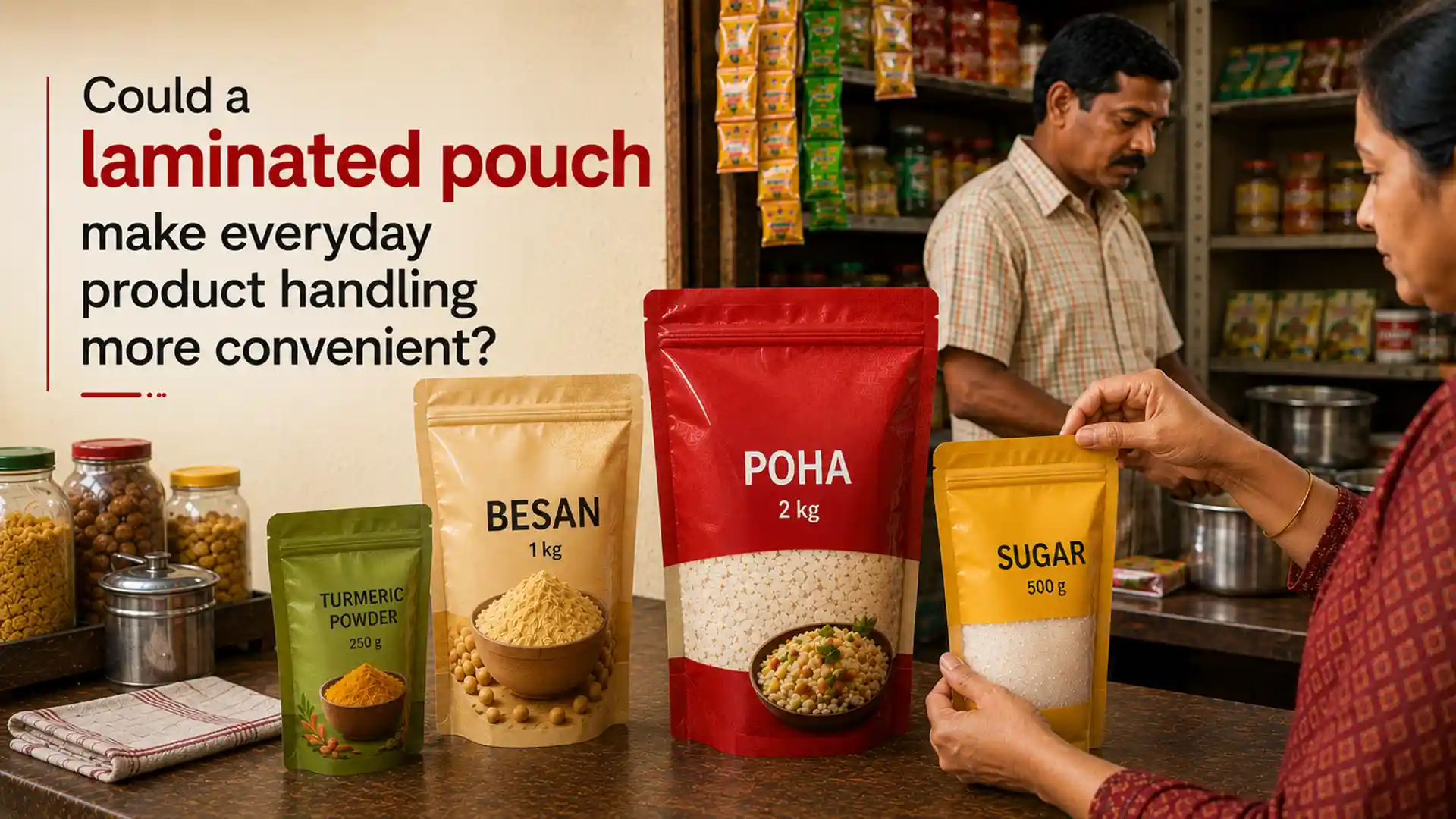
Could a laminated pouch make everyday product handling more convenient?
Packaging has to work long before a customer picks a product from a shelf. It begins on the filling line, continues through storage and transportation, and eventually reaches the person who opens, stores, and uses the product. When these stages are considered together, packaging design becomes much more than an attractive outer layer.
Ashoka Poly Laminators develops flexible packaging solutions with this complete journey in mind. A Laminated Pouch can combine different material properties to support product protection, printing, sealing, handling, and storage within one practical format. The right structure, however, depends on what the product requires and how the package will be used.
The real question is therefore not simply whether a pouch looks convenient. It is whether the design makes everyday handling easier at every relevant stage.
Convenience starts on the production floor
Before a pouch reaches a warehouse or retail shelf, it needs to work with the filling process.
The dimensions, opening format, material structure, and sealing characteristics should be compatible with the equipment used by the packaging operation. When these elements are properly matched, production teams can work with a more predictable packaging format.
This becomes particularly important for high-volume production. A small mismatch between the pouch and filling machinery can create repeated adjustments that become costly across a large production run.
Ashoka Poly Laminators considers these manufacturing requirements when developing pouch specifications, helping businesses connect the final package with the equipment used to produce it.
The product determines the protection required
Not every product needs the same packaging structure.
Some products may require protection against moisture, while others may be more sensitive to oxygen, light, aroma loss, or external contamination. The required barrier characteristics depend on the product, expected shelf life, and distribution environment.
A Laminated Pouch can bring together different layers, with each material contributing a particular function within the finished structure.
For example, one layer may support printing while another contributes barrier performance or sealing characteristics. The objective is not to add layers unnecessarily, but to create a structure suited to the actual product.
A pouch can make storage more practical
Storage requirements often receive less attention during packaging development than production and presentation.
However, filled packages may spend days or weeks in warehouses before reaching distributors or customers. Their dimensions, shape, and consistency can influence how easily they are organised, packed into secondary packaging, and moved between storage areas.
Flexible packaging can also be useful before filling because empty pouches can generally be stored differently from rigid containers.
Ashoka Poly Laminators takes these practical considerations into account when discussing pouch formats, particularly where businesses manage substantial production or distribution volumes.
Opening is part of the packaging experience
A package may perform perfectly during manufacturing and transportation but still be inconvenient if it is difficult to open.
The appropriate opening format depends on the product and how consumers are expected to use it. A single-use product may have different requirements from something that will be accessed repeatedly.
For products consumed over several occasions, resealing can also become relevant. The ability to close a package after opening may help users store the remaining contents more conveniently.
However, additional features should have a clear purpose. The best design is not necessarily the one with the greatest number of features; it is the one that addresses the actual usage requirement.
Size influences everyday handling
The dimensions of a pouch affect both the amount of product it can carry and how comfortably it can be handled.
A larger format may be appropriate for bulk household consumption, while a smaller pouch may be easier to hold, open, store, and carry. The shape also needs to work with the filling equipment and secondary packaging used during distribution.
At Ashoka Poly Laminators, these factors can be considered together when discussing a Laminated Pouch requirement.
A useful starting point is to define the product quantity, intended user, storage environment, and filling method before finalising dimensions.
Sealing connects production with product protection
The seal is one of the most important functional areas of flexible packaging.
During production, it needs to work with the available machinery and operating conditions. After filling, it needs to support the intended integrity of the package during handling, storage, and transportation.
The sealing layer should therefore be selected according to both manufacturing requirements and the characteristics of the product.
For businesses developing a Laminated Pouch, discussing sealing conditions early can help prevent packaging decisions from being made solely on the basis of appearance or material availability.
Transportation puts the package through another test
A finished pouch does not remain in one place.
It may be packed into cartons, stacked in warehouses, loaded onto vehicles, transported across regions, unloaded, and handled again before reaching the end user.
During this journey, packages can experience compression, movement, friction, and repeated handling. The selected structure needs to account for these conditions without making the package unnecessarily complex.
Ashoka Poly Laminators approaches pouch requirements with these distribution conditions in mind, particularly when customers are supplying products through multiple stages of the supply chain.
Printing can improve identification as well as presentation
Packaging has an important communication function.
The outer surface may need to display branding, product information, instructions, specifications, or other details that help users and distribution teams identify the product.
For businesses handling several product variants, clear and consistent printing can also support easier product recognition during warehouse and retail operations.
A Laminated Pouch therefore needs to accommodate visual requirements alongside physical performance. Printing should be considered as part of the overall package design rather than treated as an isolated finishing step.
Think about what happens after opening
The packaging journey does not end when the consumer opens the pouch.
If the contents are not consumed immediately, the package may need to remain practical during subsequent use and storage. This can influence the required opening method, pouch dimensions, closure options, and material properties.
Consider a dry food product used over several days. The packaging needs to protect the contents before opening, remain manageable during use, and provide an appropriate way to store whatever remains.
This is where thoughtful pouch design can influence the everyday experience beyond the retail shelf.
Every feature should solve a real problem
Good packaging development is not about adding as many features as possible.
A complex structure may increase manufacturing requirements without providing meaningful value if the product does not need those characteristics. Likewise, a basic format may be unsuitable if the application demands stronger protection or a different user experience.
The better approach is to identify the actual requirements first.
Does the product need a particular barrier? Does the package need repeated opening? Will it travel long distances? Does the filling line require a specific format?
Answers to these questions provide a more useful foundation for selecting the packaging structure.
Where manufacturer expertise becomes useful
Packaging development benefits from communication between the product team and manufacturer.
The manufacturer can consider information about the product, fill quantity, filling equipment, required dimensions, printing, sealing, storage, transportation, and intended usage. These details help translate a general packaging idea into a practical production specification.
Ashoka Poly Laminators can be involved during this stage rather than only after the packaging format has already been decided.
For businesses launching a new product or improving an existing package, early technical discussion can help identify requirements before they become production problems.
Final thoughts
A Laminated Pouch can make everyday product handling more convenient when its structure is designed around the complete product journey. Filling, protection, storage, transportation, opening, sealing, printing, and post-opening use all contribute to how practical the finished package becomes.
The strongest packaging design is not necessarily the most complicated. It is the one where every material and feature has a clear purpose and where the finished pouch matches the needs of the product and its users.
Ashoka Poly Laminators approaches flexible pouch requirements with both manufacturing and application considerations in mind, helping businesses develop Packaging Solution that fits their products rather than forcing products into a generic packaging format.
Contact Ashoka Poly Laminators
For new pouch development, customised packaging requirements, printing specifications, or bulk production, contact Ashoka Poly Laminators.
Phone: +91 7078666249
Email: apl@ashokafoam.com
Share your product, pack size, filling method, and application requirements to discuss a suitable packaging structure.

Recent Posts

Festive dispatches are growing—can your tarpaulin handle the journey?
Festive sweets need more than a pretty pouch—what keeps them protected?