Can flexible packaging materials simplify changes between different product sizes?
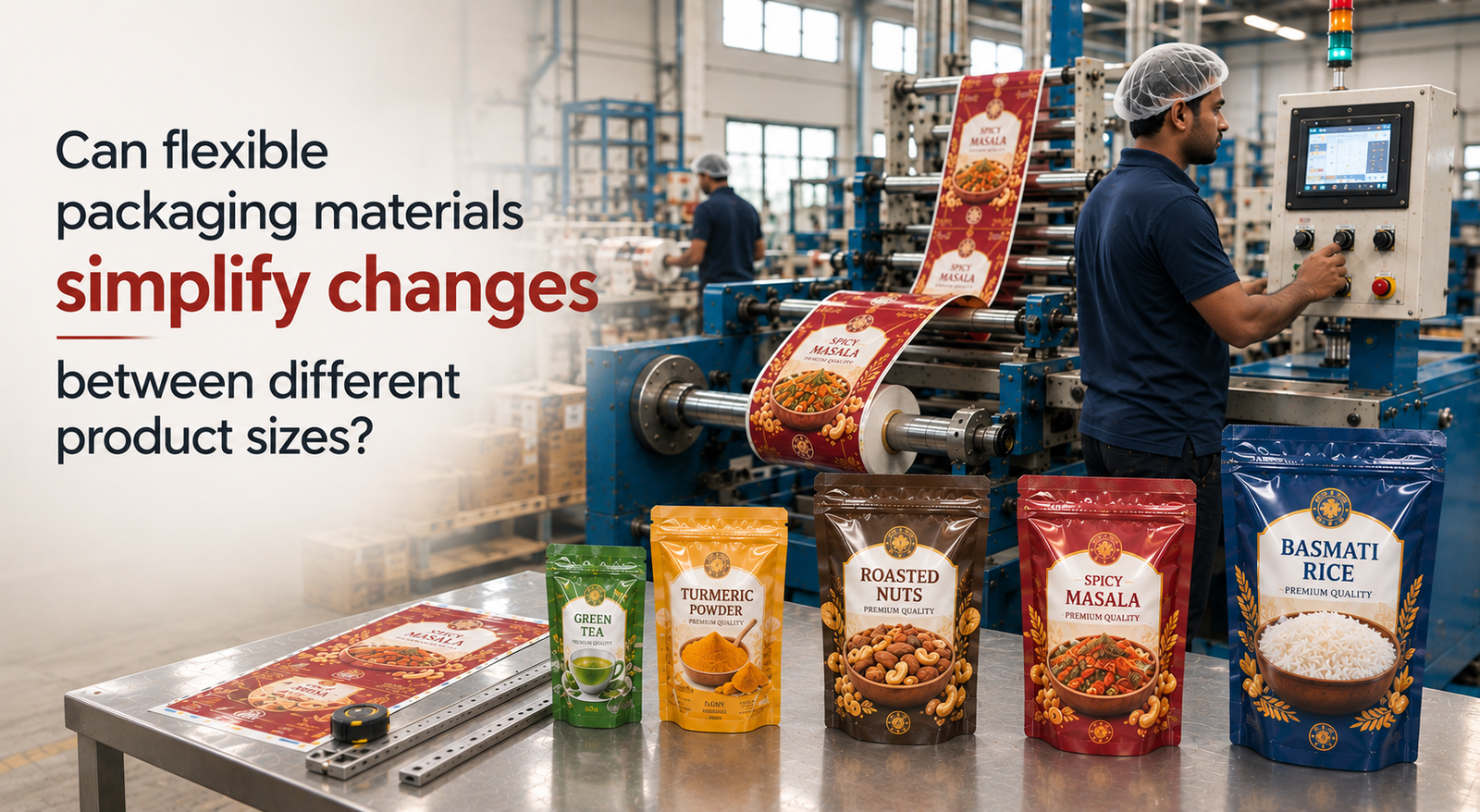
Changing the size of a product does not always mean changing the entire packaging approach. Flexible Packaging Materials can give manufacturers more room to adjust dimensions, pack formats, and sealing arrangements as product sizes change. This is useful for businesses that sell the same product in small, medium, and large quantities or frequently introduce new pack sizes.
Ashoka Poly Laminators works with flexible packaging formats where material selection and construction need to match the product and its packaging process. The important consideration is not simply whether a package can be made larger or smaller. It is whether the packaging structure can adapt without creating unnecessary changes in handling, protection, printing, or production.
Why changing pack sizes can create packaging challenges
A product range may look simple from the outside: one product, several sizes. Behind the scenes, each size can affect the amount of material required, the package dimensions, filling process, sealing area, storage space, and transport efficiency.
For example, a snack manufacturer may sell a product in a small trial pack, a regular household pack, and a larger family pack. The contents are similar, but the packaging requirements are not identical.
This is where flexible formats can offer an advantage. They allow packaging dimensions to be developed around the quantity and presentation required rather than relying on one rigid format for every variant.
Flexibility begins with the package dimensions
One of the most useful features of flexible packaging is its ability to accommodate different dimensions.
The package can be developed around factors such as:
- Product quantity
- Fill volume
- Available shelf space
- Required headspace
- Sealing requirements
- Filling equipment
This gives packaging teams greater control when developing several sizes of the same product.
Rather than treating every new size as an entirely separate packaging concept, manufacturers can evaluate how an existing structure can be adapted to the new dimensions.
The material structure still has to suit the product
Changing the size of a package does not remove the need to select an appropriate material structure.
Different products may require different levels of protection against moisture, oxygen, light, aroma loss, grease, or handling damage. The required barrier performance depends on the product and its expected shelf life.
For this reason, Ashoka Poly Laminators approaches flexible packaging from a product-specific perspective rather than assuming that one structure automatically works for every application.
A larger pouch and a smaller pouch may hold the same product, but their material usage and sealing geometry can still require careful evaluation.
Printing does not have to follow one fixed size
Product ranges often need consistent branding across different pack sizes.
Flexible packaging can support this by allowing the same visual identity to be adapted across different dimensions. The artwork can be positioned according to the available printable area while keeping important information visible.
This is especially useful when a brand wants its smaller and larger packs to look like part of the same product family.
The design process should account for the actual dimensions early. Important information should not become cramped simply because the package has been reduced in size.
What happens to sealing when the size changes?
Sealing is another area that needs attention when packaging dimensions change.
The seal must be suitable for the chosen material structure and packaging process. A change in pouch width, height, or fill volume can affect how the package behaves during filling and sealing.
For businesses introducing several pack sizes, it can therefore be useful to review the packaging process as a complete system rather than changing dimensions alone.
A well-planned format can make transitions between sizes more predictable for production teams.
Smaller packs and larger packs solve different problems
Size variation usually exists because customers have different needs.
A smaller package may suit trial purchases, individual consumption, or convenience-focused applications. A larger format may be intended for families, institutions, bulk users, or better value per unit.
Flexible Packaging Materials can support these different requirements while maintaining a common product identity.
The goal is not to make every size identical. It is to create a family of packages that each performs its intended job while remaining consistent with the wider product range.
Material efficiency becomes more important as sizes multiply
When a company offers many pack sizes, small packaging decisions can have a larger operational effect.
An unnecessarily large package may use more material than needed. A poorly proportioned format may also occupy additional storage or transport space.
This is why packaging development should consider the relationship between pack dimensions and actual fill requirements.
At Ashoka Poly Laminators, discussions around flexible formats can take these practical factors into account when developing packaging for different product quantities.
Changes can also affect inventory planning
Introducing another pack size creates more than a new printed package.
It can create another packaging specification, another SKU, another inventory requirement, and potentially another production setup.
Flexible Packaging does not eliminate these operational considerations, but a well-planned packaging family can make them easier to manage.
For established product ranges, standardising compatible material structures and design principles across sizes may help simplify procurement and packaging development.
A simple example: one product, three quantities
Consider a powdered food product available in 250 g, 500 g, and 1 kg packs.
The three packages need different dimensions because the fill quantities are different. However, they may still share a compatible material structure, similar printing treatment, and related sealing approach.
The smaller package can focus on convenience. The medium size can serve regular household use. The larger format can reduce the frequency of repurchasing.
The packaging strategy therefore changes with quantity without requiring three completely unrelated packaging concepts.
When flexibility has limits
Flexible packaging should not be treated as a universal solution for every size variation.
Very large changes in product volume may require a different format or construction. Filling machinery can also place limits on dimensions, sealing arrangements, and package handling.
Similarly, a product with significantly different protection requirements may need a different laminate structure rather than simply a larger version of an existing pack.
Good packaging development recognises these limits before production begins.
What should packaging teams evaluate before changing sizes?
When a new product size is being introduced, it helps to look beyond the package dimensions.
Consider the following questions:
- Does the existing material structure provide the required product protection?
- Can the filling and sealing equipment accommodate the new dimensions?
- Will the package remain practical to handle?
- Is the printed artwork suitable for the new surface area?
- Will the new size use material efficiently?
- Can the new format fit existing storage and transport arrangements?
These checks can prevent a seemingly simple size change from creating avoidable production problems.
Why manufacturer involvement can help
Packaging changes are easier to manage when the material supplier understands the complete application.
A manufacturer can discuss the relationship between material structure, dimensions, printing, sealing, and the intended product. This is particularly useful when a business is moving from one pack size to several.
Ashoka Poly Laminators can work with application requirements when developing flexible packaging solutions, helping businesses consider the packaging structure alongside the practical demands of different product formats.
The earlier these factors are considered, the less likely it is that a size change will require major adjustments later in the process.
Final thoughts
Product sizes change because customer needs change. Packaging needs to keep pace without making every new size unnecessarily complicated.
Flexible Packaging Materials can provide useful adaptability because dimensions, structures, printing, and sealing arrangements can be developed around different quantities and product formats. But flexibility works best when the package is designed with the product, machinery, storage, and distribution requirements in mind.
For businesses expanding a product range, the real advantage is not simply having more packaging options. It is having a packaging approach that can evolve with the range.
Ashoka Poly Laminators can help businesses evaluate flexible packaging requirements when developing new sizes or refining existing formats.
Planning a new pack size? Discuss the product, quantity, dimensions, and packaging process to identify a suitable flexible format.
Phone: +91 7078666249
Email: apl@ashokafoam.com
Request a packaging specification suited to your storage and shipment requirements.

Recent Posts

Festive dispatches are growing—can your tarpaulin handle the journey?

Festive sweets need more than a pretty pouch—what keeps them protected?