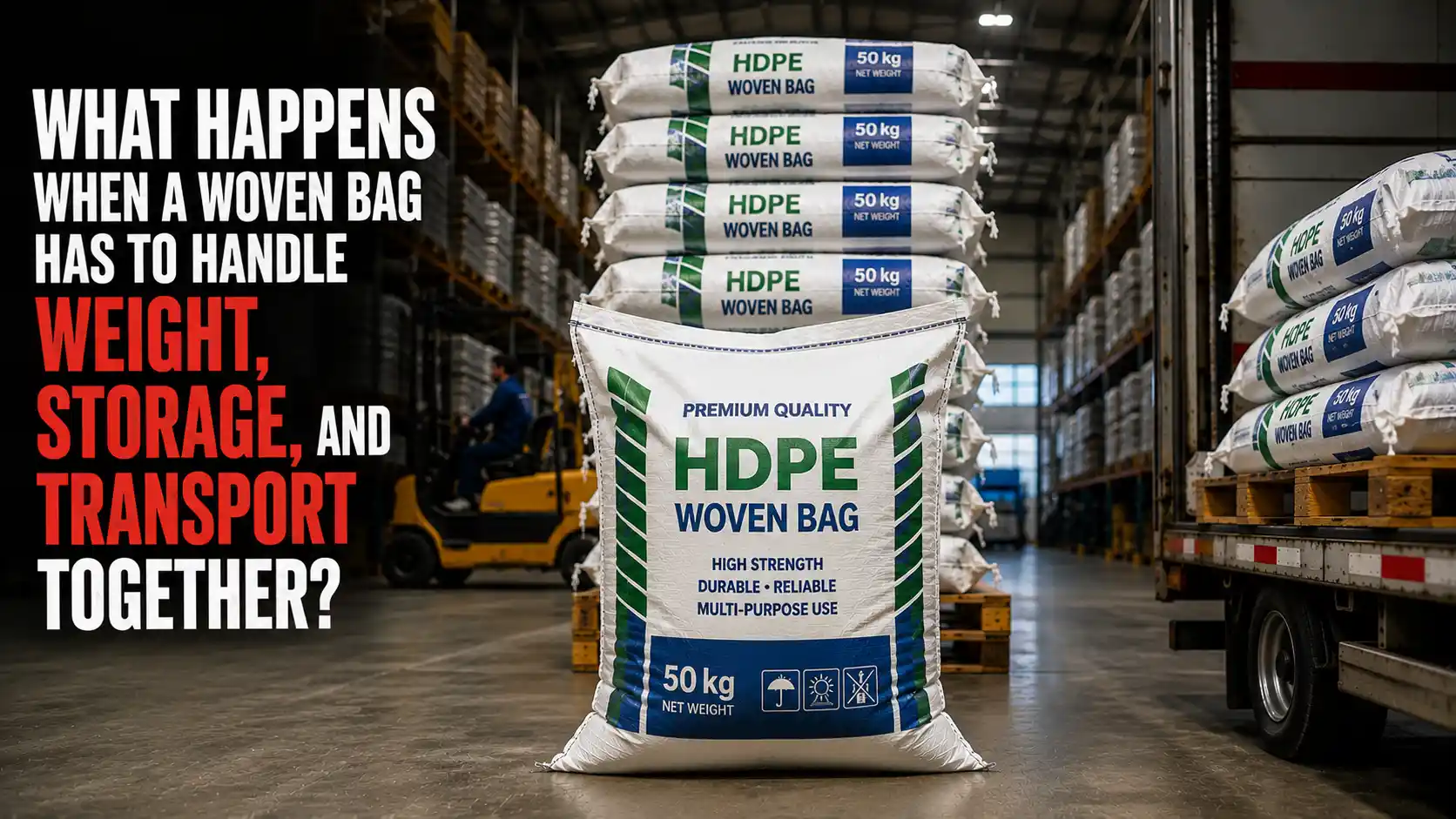
What happens when a woven bag has to handle weight, storage, and transport together?
A woven bag may spend only a short time being filled, but it can remain part of the supply chain for weeks or months. After filling, it may be lifted, stacked, transported, unloaded, and stored again. When all these demands come together, the packaging needs to be selected according to the complete journey rather than one isolated requirement.
An HDPE Woven Bag is designed around this kind of practical use. Its woven construction provides a structured packaging format for businesses handling bulk materials, while the final bag specification can be adapted according to the product, load, storage environment, and transportation conditions. Ashoka Poly Laminators focuses on these application requirements when developing woven packaging for industrial and commercial users.
Weight is only the beginning
The first question buyers usually ask is whether the bag can carry the required load. That is important, but it does not tell the whole story.
A filled bag also has to cope with lifting, stacking, movement, and changes in position. The way the weight is distributed inside the bag can affect how the fabric and seams experience stress during handling.
This is why an HDPE Woven Bag should be considered according to both its intended load and its handling cycle. A bag used once for short-distance movement may have different requirements from one that is repeatedly shifted between storage and transport.
Ashoka Poly Laminators considers the relationship between load requirements and practical handling when developing woven bags for different applications.
What happens when bags are stacked?
Storage introduces a different type of pressure.
When filled bags are placed one above another, the lower layers carry the weight of the bags positioned above them. The duration of stacking also matters because the packaging may remain under pressure for an extended period.
Warehouse conditions can vary considerably. Some bags may remain indoors on organised pallets, while others may be stored in environments where temperature, humidity, dust, and handling conditions are less controlled.
For an HDPE Woven Bag, the appropriate construction therefore depends not only on what goes inside but also on how the filled bags will be stored afterward.
Transport changes the stress again
A bag that performs well while sitting in a warehouse can experience a completely different set of forces during transportation.
Vehicle movement can cause loads to shift. Bags may rub against neighbouring packages or surfaces during loading and unloading. Long-distance movement can involve repeated vibration, compression, and handling before the shipment reaches its destination.
The packaging therefore needs to remain suitable beyond the point of filling.
Ashoka Poly Laminators considers transportation conditions when discussing woven bag requirements so that the selected format reflects the complete movement cycle rather than only the initial loading stage.
The contents influence the bag
There is no single woven bag specification that suits every bulk product.
A bag carrying agricultural material may have different requirements from one used for industrial raw materials or other dry goods. Product weight, particle characteristics, filling method, storage duration, and transportation route can all influence the appropriate construction.
This makes product information an important part of the purchasing discussion.
Before ordering an HDPE Woven Bag, buyers should explain what the bag will carry and how it will move through the supply chain. This gives the manufacturer a clearer understanding of the conditions the finished packaging needs to handle.
Construction matters beyond the fabric
The woven fabric is an important part of the bag, but it is not the only consideration.
Dimensions, stitching, opening and closing arrangements, and finishing can all influence how the completed bag behaves during filling and handling. The design should therefore be considered as a complete packaging format rather than as fabric alone.
For businesses purchasing an HDPE Woven Bag, this is particularly relevant when bags are used repeatedly or handled mechanically.
Ashoka Poly Laminators evaluates the practical requirements of the finished packaging so that construction decisions remain connected to the intended application.
Storage and transport should be considered together
It is easy to treat warehouse storage and transportation as separate issues. In reality, they are usually part of the same product journey.
A bag may be filled at a manufacturing facility, stored temporarily, loaded onto a truck, transported to a distributor, unloaded, and stored again before reaching the final customer. Each stage places different demands on the packaging.
The right specification should therefore account for the entire cycle.
An HDPE Woven Bag selected with this broader perspective can be better aligned with the actual conditions it is expected to encounter rather than being chosen solely according to its stated capacity.
Repeated handling reveals the real requirement
Some bags are used once and discarded. Others are handled multiple times before their contents reach the final destination.
Repeated movement can place additional stress on the packaging, particularly when bags are lifted, dragged, stacked, or repositioned during distribution.
For this reason, buyers should consider handling frequency when discussing their requirements with an HDPE Woven Bag manufacturer. The expected number of handling cycles can provide useful context when determining the appropriate construction.
This application-focused approach is also useful for businesses that need recurring packaging supplies because it creates a clearer specification for future orders.
What should buyers discuss before ordering?
A practical packaging discussion can begin with a few straightforward details. Buyers should explain the approximate product weight, filling method, storage conditions, transportation distance, expected handling frequency, and whether the bags will be stored indoors or outdoors.
These details help connect the specification with actual operating conditions.
For companies sourcing an HDPE Woven Bag, it is also useful to discuss required dimensions and printing or identification requirements at the beginning rather than treating them as separate decisions later.
Ashoka Poly Laminators can use this information to understand the application and develop woven packaging requirements around the way the bags will actually be used.
When one bag has to work across the supply chain
The strongest packaging decisions often come from looking beyond a single stage.
A bag that carries weight effectively but becomes difficult to manage during storage may create operational problems. Similarly, packaging that works well in a warehouse but is poorly suited to repeated transportation can create avoidable issues later.
The objective is therefore balance.
An HDPE Woven Bag should be selected according to the relationship between load, handling, storage, and transportation. When these factors are considered together, procurement teams can make decisions based on the actual demands placed on the packaging.
Ashoka Poly Laminators works with businesses to understand these requirements and develop Woven Packaging suited to different industrial and commercial applications.
Final takeaway
Weight, storage, and transportation are not separate packaging challenges. They form one continuous journey from filling to final delivery. A woven bag needs to be considered according to how the product will be loaded, moved, stacked, transported, and stored throughout that journey.
For businesses evaluating an HDPE Woven Bag, the most useful approach is to start with the application rather than simply selecting a standard capacity. Ashoka Poly Laminators brings practical manufacturing experience to woven packaging requirements, helping businesses align bag construction with product characteristics, handling conditions, storage needs, and transportation demands.
Contact Ashoka Poly Laminators
For customised woven bag requirements, bulk orders, or help selecting a suitable specification, contact Ashoka Poly Laminators.
Phone: +91 7078666249
Email: apl@ashokafoam.com

Recent Posts
Festive dispatches are growing—can your tarpaulin handle the journey?
Festive sweets need more than a pretty pouch—what keeps them protected?