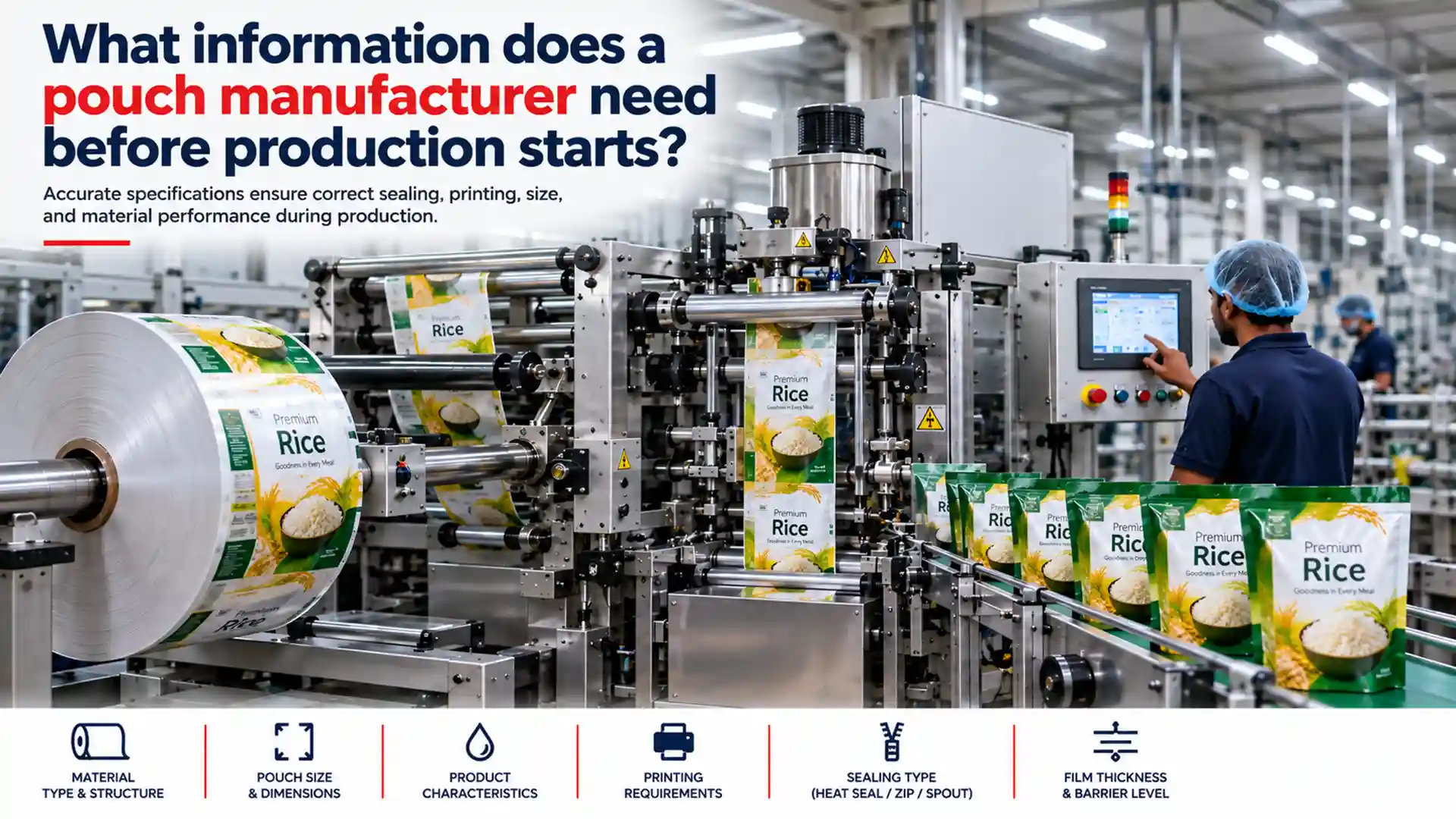
What information does a pouch manufacturer need before production starts?
Before pouch production begins, a manufacturer needs clear information about the product, pouch size, material, printing and filling process. Sharing these details early helps avoid incorrect dimensions, artwork changes and production delays. A Laminated Pouch Manufacturer can prepare the right pouch specification much more easily when the buyer provides a complete and practical brief.
For Ashoka Poly Laminators, the goal is to understand how the pouch will be used before production starts. The pouch should suit the product, filling process, storage conditions and expected handling—not just look right on paper.
Start with the product
The first thing a manufacturer needs to know is what will go inside the pouch.
A dry food product, powder, spice, snack or other packaged product may have different requirements. The product’s weight, volume, texture and handling characteristics can affect the pouch format.
For example, a pouch for a lightweight snack may need a different size from one holding a dense powder, even if both products are sold in similar quantities.
Ashoka Poly Laminators can use this information to understand the basic requirements before discussing the pouch structure and dimensions.
Confirm the filling quantity
The target fill quantity is one of the most important details.
Tell the manufacturer whether the pouch will hold 100 g, 250 g, 500 g, 1 kg or another quantity. If several sizes are required, provide the complete list rather than developing one format and adding other sizes later.
Fill quantity helps determine the practical pouch dimensions.
It also gives the production team a better idea of how the pouch will behave during filling, sealing and handling.
Share the required pouch dimensions
If you already have preferred dimensions, provide them to the manufacturer.
If you do not, that is not necessarily a problem. The manufacturer can discuss suitable dimensions based on the product quantity, shape and filling process.
It is useful to specify whether the dimensions provided are:
- Finished pouch dimensions
- Flat pouch dimensions
- Approximate dimensions
- Dimensions based on an existing pouch
This avoids confusion during sampling and production.
Explain how the pouch will be filled
The filling method can affect pouch design.
A pouch filled manually may have different practical requirements from one filled using an automated packaging machine. Machine compatibility can influence dimensions, opening arrangements and sealing considerations.
Businesses should therefore tell the Laminated Pouch Manufacturer whether filling will be manual, semi-automatic or fully automated.
If an existing machine is being used, providing its relevant pouch specifications can make the discussion more accurate.
Decide how the pouch will be sealed
The sealing method should be established before production.
Different pouch formats can use different sealing arrangements depending on the product and filling process. The manufacturer needs to understand how the pouch will be closed after filling.
If the business already has a preferred format, share a sample or drawing.
If not, APL Packaging Products can be discussed according to the product and production process so that the pouch format is selected for a clear reason.
Provide the artwork early
Artwork is another important production input.
The manufacturer needs the correct logo, product name, design, text, images and other required information before printing begins.
Late artwork changes can delay production, particularly when cylinders, printing arrangements or approved proofs are already prepared.
Businesses should check:
- Product name
- Brand name
- Net quantity
- Product information
- Required declarations
- Contact information
- Barcode or other identification
- Spelling and artwork placement
A final approved artwork file can help prevent avoidable production changes.
Tell the manufacturer where the pouch will be used
The final application matters.
A pouch used for a dry food product may have different requirements from one used for another type of product. Storage duration, transportation and handling can also influence the specification.
For food-related applications, businesses should clearly communicate the product type and intended use.
Ashoka Poly Laminators can then assess the packaging requirement around the actual application instead of treating every pouch as the same.
Discuss material requirements
The product and application help determine which material structure should be considered.
Businesses may already have a specification from an existing supplier. If so, sharing that information can make comparison easier.
If the business is developing a new pouch, the manufacturer needs enough information to discuss the appropriate structure for the intended product.
The focus should be on what the pouch needs to do—such as protect the contents, support sealing or provide the required presentation—rather than simply choosing a material because it is commonly used.
Confirm the number of pouch variants
A product range may require several pouch designs.
For example, one brand may need different sizes for different quantities or separate artwork for different product variants.
Providing the complete requirement at the beginning helps the production team understand the scope of the order.
APL Flexible Packaging can be considered when businesses need multiple pouch formats within a wider packaging range.
This can also make production planning easier when several related specifications need to be coordinated.
Share expected order quantity
Order volume is another important detail.
A manufacturer needs to know whether the requirement is for a small trial quantity, a product launch or regular bulk production.
Expected volume can help businesses discuss production planning, delivery requirements and future repeat orders more clearly.
It is also useful to communicate whether the first order is likely to be followed by regular production. This gives the supplier better context when discussing the packaging requirement.
Give details about storage and transportation
The pouch does not stop working once it leaves the filling machine.
Finished packs may be stored in warehouses, transported to distributors and handled several times before reaching customers.
Businesses should therefore mention important storage and distribution conditions where relevant.
For example, a product may have a long distribution cycle or be exposed to different environmental conditions. These details can help the manufacturer understand the practical requirements of the finished pouch.
Ashoka Poly Laminators considers these factors when discussing packaging applications so that the pouch specification reflects its intended use.
A simple production brief can prevent confusion
A buyer does not need to create a complicated technical document.
A clear brief can simply include:
Product: What is being packed?
Quantity: How much product goes into each pouch?
Size: What dimensions are required?
Filling: How will the pouch be filled?
Sealing: How will it be closed?
Material: Is there an existing specification?
Artwork: Is the final design ready?
Variants: How many sizes or designs are needed?
Volume: What quantity is required?
Delivery: Where and when will the finished pouches be needed?
This information gives the Laminated Pouch Manufacturer a strong starting point for production planning.
Why Ashoka Poly Laminators?
Good pouch production starts with a clear understanding of the customer’s requirement.
Ashoka Poly Laminators can work with businesses that need laminated pouches for different products, quantities and packaging processes. The discussion can begin with the product and move through dimensions, filling, sealing, artwork and order requirements.
APL Packaging Materials can also be evaluated according to the intended pouch application rather than using the same specification for every product.
Providing accurate information at the beginning helps both sides reduce unnecessary changes later.
Get the pouch brief right before production
Most production problems are easier to prevent than to correct after manufacturing has started.
Before approving a pouch order, make sure the product details, quantity, dimensions, filling method, sealing requirements, artwork and order volume are clearly communicated.
A Laminated Pouch Manufacturer can then work from a defined requirement and prepare the pouch around the actual application.
If you are developing a new pouch or changing an existing format, Ashoka Poly Laminators can discuss the requirement with your team.
Phone: +91 7078666249
Email:apl@ashokafoam.com

Recent Posts
What packaging materials do you need when your products require different pack sizes?
What information does a pouch manufacturer need before production starts?