
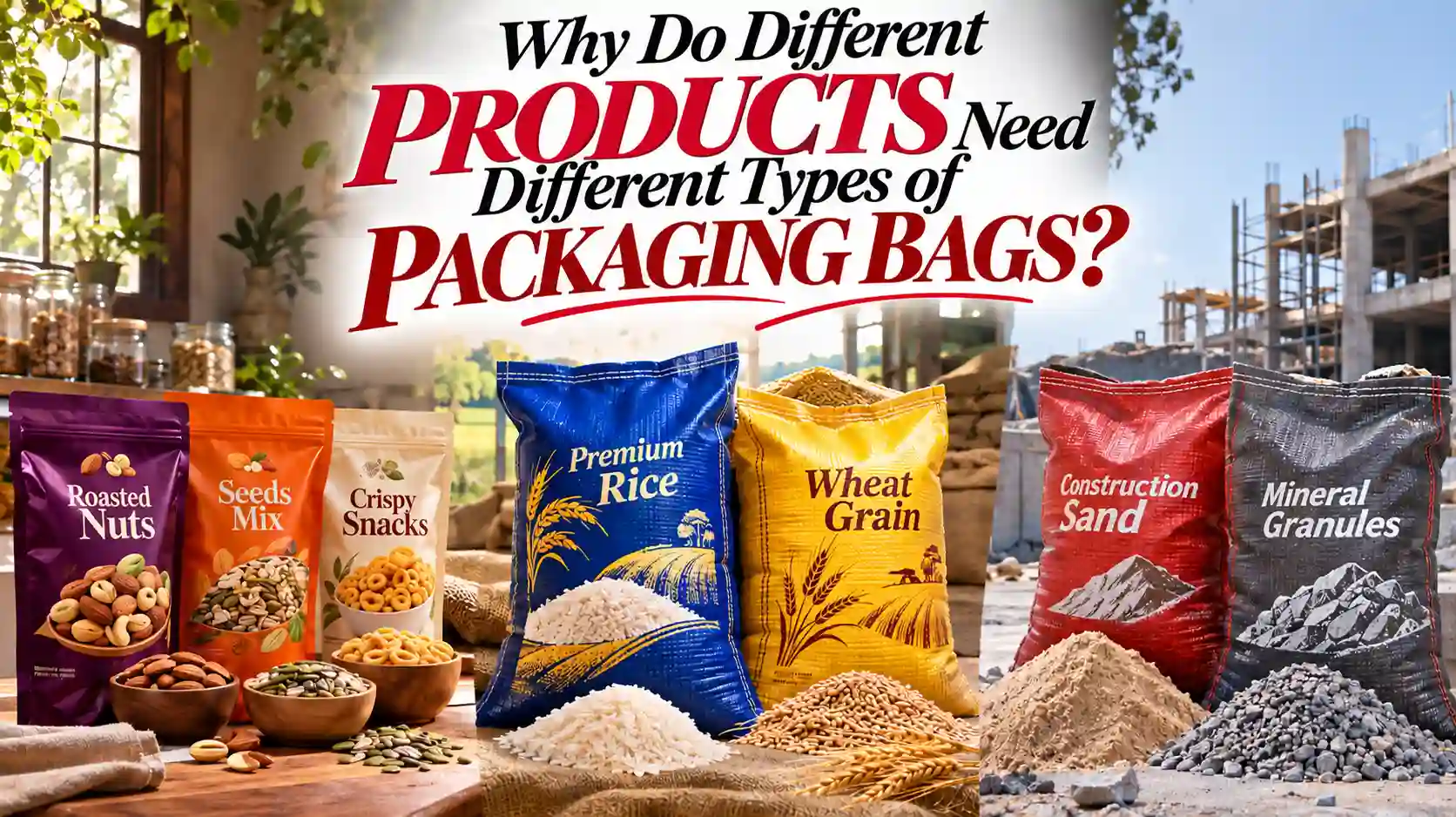
Why do different products need different types of packaging bags?
Have you ever wondered why rice is packed in one type of bag, snacks in another, and industrial materials in something completely different? Packaging is not simply about putting a product inside a bag. Each product has its own weight, texture, storage needs and transportation challenges. The right packaging helps protect the contents, makes handling easier and gives customers a better experience.
For businesses, understanding these differences can prevent common problems such as torn bags, product leakage, moisture exposure and damaged goods. At Ashoka Poly Laminators, packaging materials are developed around different product requirements, because a bag that works well for one application may not perform equally well for another.
A packaging bag does more than carry a product
Imagine packing flour in a thin shopping bag or storing sharp-edged industrial material in packaging designed for lightweight goods. The packaging might look suitable initially, but problems can appear during filling, lifting, stacking or transportation.
Every product behaves differently. Some are lightweight but need protection from moisture. Others are heavy and place pressure on the bottom and seams of a bag. Food products may need packaging that supports hygiene and helps maintain product quality, while agricultural materials often require bags suitable for storage and bulk handling.
This is why businesses working with a Best Packaging Bag Factory in India should understand the purpose of the packaging rather than focusing only on its appearance.
The bag must be suitable for the product throughout its journey, from the filling stage to storage, distribution and final use.
Why food products need a different kind of packaging
Food packaging has requirements that are different from those of construction materials or agricultural goods. A packet containing spices, snacks, flour or other food items must be designed around the product’s characteristics.
For example, snacks can lose their crispness when exposed to moisture. Spices may need packaging that helps protect their aroma and quality. Powdered food products can create problems if the pouch does not seal properly.
Flexible laminated pouches are commonly used for many food applications because their layered structure can be designed to provide suitable barrier, printing and sealing properties.
The exact material depends on the food product, its shelf-life requirements, storage conditions and filling process. Not every laminated pouch has the same structure or performance.
Ashoka Poly Laminators manufactures laminated pouches for packaging applications where the material structure, appearance and intended use need to work together.
Why heavy products require stronger bags
A bag carrying 25 kg or 50 kg of material faces a different challenge from a pouch holding a small quantity of snacks. Its packaging must handle the weight of the contents and the pressure created during lifting, stacking and transportation.
Products such as grains, seeds, fertilizers, animal feed and industrial materials are often packed in woven bags.
HDPE woven bags are made by interlacing narrow plastic tapes to create a fabric-like structure. This construction makes them suitable for many bulk packaging applications. Their performance still depends on factors such as fabric construction, material quality, dimensions, stitching and the weight they are designed to carry.
BOPP bags are another option for certain applications. They combine a woven base with a printed outer layer, making them useful when businesses need both bulk-packaging functionality and attractive product presentation.
At Ashoka Poly Laminators, BOPP bags by Ashoka Poly Laminators and HDPE woven bags by Ashoka Poly Laminators serve different packaging requirements. The appropriate option depends on the product and its handling conditions.
What happens when packaging does not match the product?
Using unsuitable packaging can create problems that may not become visible until the product reaches a warehouse, distributor or customer.
Some common examples include:
- Bag tearing: Packaging that cannot handle the product’s weight or handling conditions may tear during lifting or transportation.
- Moisture exposure: Products sensitive to humidity may experience quality problems if the packaging does not provide a suitable moisture barrier.
- Poor sealing: Food powders, granules and other small materials may leak if the sealing arrangement is unsuitable.
- Difficult storage: Bags with unsuitable dimensions or construction can make stacking and warehouse handling less convenient.
- Product presentation issues: Packaging with poor print quality or an unsuitable surface may affect how a product appears on retail shelves.
These problems can increase product loss, handling costs and customer complaints. A suitable packaging structure helps reduce such risks, although actual performance should always be checked under real operating conditions.
The material, weight and product shape all matter
Two products may have the same weight but still need different packaging. Consider a 25 kg bag of grain and a 25 kg bag of granular industrial material. Their weight is identical, but their texture, particle size, filling method and storage conditions may be different.
A few important factors influence packaging requirements:
Product weight: The bag must be designed for the expected load, including the stress created when it is lifted or moved.
Product texture: Fine powders, sharp particles, irregular materials and smooth granules behave differently inside packaging.
Moisture sensitivity: Products that can absorb moisture may require a suitable laminated or barrier structure.
Storage conditions: Indoor warehouses, outdoor storage and long-distance transportation create different packaging demands.
Filling and handling methods: Manual filling, automated machines, stitching, heat sealing and bulk handling can influence the required bag design.
This is why packaging specifications should be discussed in relation to the actual product rather than relying on a standard bag size or material for every application.
Why packaging requirements change from one industry to another
Different industries handle products in different ways, so their packaging needs naturally vary.
Agricultural businesses commonly use woven bags for grains, seeds and similar bulk materials. Food manufacturers often use laminated pouches for snacks, spices and packaged food products. Construction and industrial businesses may need packaging designed for heavier materials and repeated handling.
Retail businesses also consider printing, product visibility and convenient opening. Meanwhile, distributors and wholesalers may place greater importance on bag strength, stacking and transportation.
Ashoka Poly Laminators works across flexible and industrial packaging categories, including laminated pouches, BOPP bags and HDPE woven packaging. These product categories address different applications rather than serving as interchangeable packaging options.
For businesses exploring a Best Packaging Bag Factory in India, the important consideration is whether the manufacturer can understand the intended application and discuss suitable packaging specifications.
How the right packaging supports everyday business operations
Packaging decisions affect more than product protection. They can influence the speed of filling, warehouse organization, transportation efficiency and the experience of the final customer.
A properly designed bag can make products easier to handle and store. Suitable dimensions can help with stacking, while appropriate material and sealing arrangements can reduce avoidable packaging failures.
Before finalizing a packaging order, businesses should discuss the product being packed, its weight, filling process, storage environment and transportation conditions. Testing samples under actual operating conditions is also useful. It helps identify problems with sealing, stitching, handling or material performance before larger quantities are ordered.
Ashoka Poly Laminators focuses on packaging requirements across different product categories, helping businesses explore options that match their intended applications.
Frequently asked questions
1. Why can’t one packaging bag be used for every product?
Products differ in weight, shape, texture, moisture sensitivity and storage requirements. A bag suitable for lightweight food items may not be strong enough for heavy industrial materials.
2. Which bags are commonly used for heavy products?
HDPE woven bags and certain BOPP woven bags are commonly used for bulk products such as grains, seeds, fertilizers and industrial materials. The appropriate construction depends on the required load and handling conditions.
3. Are laminated pouches suitable for food packaging?
Yes. Laminated pouches are used for products such as snacks, spices and other packaged foods. Their material structure should be selected according to the product’s barrier, sealing and storage requirements.
4. What causes packaging bags to tear during transportation?
Common causes include unsuitable material construction, excessive loading, weak stitching, poor handling and improper stacking. Packaging should be tested for the conditions it will experience.
5. Does bag thickness determine packaging strength?
Not by itself. Material quality, fabric construction, dimensions, stitching and the overall design also affect performance. Thickness alone cannot guarantee that a bag will carry a particular load safely.
Packaging should match the product, not just the order quantity
A good packaging decision begins with understanding what goes inside the bag and what happens to it afterward. Food, agricultural goods, retail products and industrial materials all have different requirements, so their packaging should reflect those differences.
Ashoka Poly Laminators offers packaging options across different applications, including laminated pouches, BOPP bags and HDPE woven bags. Businesses looking for a Best Packaging Bag Factory in India should focus on product suitability, practical performance and consistent specifications.
Need packaging for your product? Contact Ashoka Poly Laminators to discuss your requirements and bulk orders.
Phone: +91 7078666249
Email: apl@ashokafoam.com

Recent Posts
Why do some packaging bags look attractive but fail during handling?
Why do some food packets stay sealed while others open during storage?