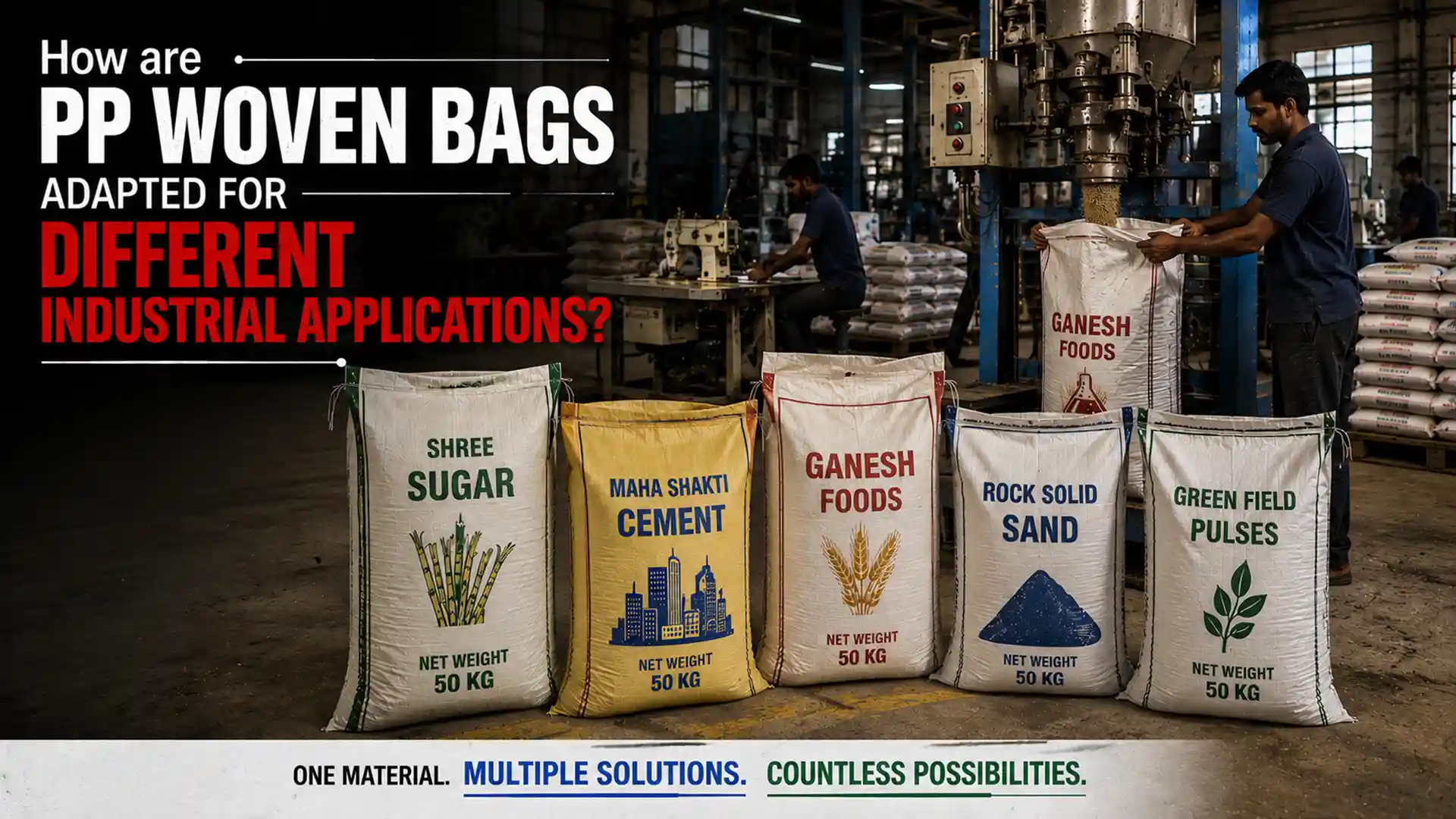
How are PP woven bags adapted for different industrial applications?
Industrial packaging rarely follows a one-size-fits-all model. A bag used for agricultural products may need different characteristics from one handling construction materials, chemicals, animal feed, or industrial raw materials. Product weight, material behaviour, filling equipment, storage conditions, transportation, and handling methods all influence the final packaging requirement.
Ashoka Poly Laminators develops woven packaging with these application differences in mind. As a PP Woven Bags Supplier, the focus is not simply on producing one standard format but on understanding what the packaged material needs from the bag.
The result can be a more appropriate combination of fabric construction, dimensions, printing, lamination, and finishing for the intended industrial use.
The product determines the starting point
The first consideration is the material going inside the bag.
Granular products, powders, agricultural commodities, and industrial materials can behave very differently during filling and transportation. Their density, particle size, flow characteristics, and required fill weight influence the packaging format.
A bag designed for a lightweight material may not need the same construction as one carrying a substantially heavier product. Similarly, a powder may require different considerations from a coarse granular material.
This is why application information should be established before selecting the final bag specification.
Fabric construction can be adjusted
PP woven fabric is created by interlacing polypropylene tapes, producing a structure suitable for many bulk packaging applications.
The construction can be selected according to the expected load and handling conditions. For businesses moving heavy products, the fabric specification becomes particularly important because filled bags may experience repeated lifting, stacking, and transportation.
The appropriate construction should provide the performance required by the application without automatically over-specifying the material.
For a PP Woven Bags Manufacturer, understanding the expected working conditions helps determine which construction is appropriate for the customer.
Size follows the filling requirement
Bag dimensions are closely connected with the product and filling process.
A manufacturer may need to consider the quantity being packed, product density, filling equipment, storage arrangement, and final handling method before determining the dimensions.
For example, a bag designed for a high-volume agricultural commodity may have different dimensional requirements from packaging intended for a denser industrial material.
Standardisation can also become useful when a business fills large quantities regularly. Consistent dimensions can make production, stacking, storage, and procurement easier to manage.
Agriculture requires practical bulk handling
Agricultural products are among the common applications for woven packaging.
Rice, grains, seeds, animal feed, and other commodities may travel through several stages after filling. They can be stored in warehouses, transported over long distances, stacked, unloaded, and moved again before reaching the customer.
This creates a need for packaging that suits repeated bulk handling.
For such applications, buyers may consider bag dimensions, fabric construction, printing, closure method, and whether additional protection is required based on the product and distribution environment.
Construction materials create different demands
Construction and building materials can place substantial physical demands on packaging.
Products such as sand, aggregates, powders, and other industrial materials may be dense and heavy. Filled bags can be moved manually or mechanically and may experience considerable handling during loading and unloading.
The packaging specification therefore needs to reflect the actual product weight and handling routine.
A PP Woven Bags Supplier can provide more useful guidance when the buyer explains how the material will be filled, stored, moved, and transported rather than simply requesting a generic bag.
Industrial materials may need additional protection
Some industrial products have requirements that go beyond basic containment.
Depending on the material, businesses may need to consider moisture protection, contamination control, identification, or improved surface performance.
In suitable applications, lamination can be incorporated into woven packaging to provide an additional functional layer. The decision should depend on what the product requires rather than being treated as a standard feature.
This application-specific approach allows the packaging structure to remain focused on its intended purpose.
Printing has both commercial and operational value
Industrial bags are often printed for more than branding.
Printed information can help identify the product, communicate specifications, distinguish different grades, and support inventory management. For consumer-facing agricultural products, strong graphics may also contribute to shelf presentation.
The number of colours, artwork requirements, printing area, and surface characteristics should be considered before production.
For businesses ordering custom packaging, Ashoka Poly Laminators can take printing requirements into account alongside the physical specifications of the woven bag.
Closure and handling need to match the workflow
The way a bag is filled and closed can influence its suitability for a particular operation.
Some businesses rely on automated filling and stitching equipment, while others may use different closure arrangements. The finished bag should work with the equipment and handling practices already established at the facility.
A packaging format that is excellent for one filling operation may be inconvenient for another.
This is why buyers should communicate their existing machinery and packaging workflow when discussing requirements with a PP Woven Bags Manufacturer.
Storage conditions can change the specification
The packaging journey continues after filling.
Some products remain in warehouses for extended periods, while others move rapidly from production to distribution. Bags may be stacked, palletised, transported, or stored in different environments.
The expected storage period and handling conditions can influence the appropriate packaging design.
For example, a business holding large quantities of agricultural material for an extended period may have different requirements from a manufacturer shipping industrial material immediately after production.
Understanding these differences helps prevent a generic packaging specification from being applied to every application.
A bag may need to work across several supply-chain stages
Consider an industrial product that leaves the manufacturing facility, moves to a distributor, and is eventually delivered to several customers.
The same filled bag may be handled multiple times along this route.
It needs to remain practical during loading, storage, transport, unloading, and final handling. The more stages involved, the more useful it becomes to consider the complete journey when developing the packaging.
This is one reason application-led packaging development can be more effective than selecting a bag based solely on its appearance or initial price.
Customisation should solve a specific requirement
Custom packaging does not mean changing every characteristic.
A business may only need a different size, printing format, closure, or additional layer. Another customer may require a more specific combination of these features because of the product and filling system.
The useful question is: what needs to change for the packaging to work better in this application?
Once that is clear, the manufacturer can focus on the relevant specifications rather than adding unnecessary complexity.
What should an industrial buyer provide?
A clear packaging brief can make product development much easier.
Before approaching a supplier, buyers should ideally know:
- Product being packed
- Approximate fill weight
- Required bag dimensions
- Filling and closure method
- Storage conditions
- Transportation requirements
- Printing or branding needs
- Expected order quantity
These details give the manufacturer practical information for developing a suitable specification.
They also make supplier comparisons more meaningful because different quotations can be evaluated against the same technical requirements.
One woven bag format cannot serve every application
The versatility of woven packaging comes from its ability to be adapted rather than from having one universal specification.
Agricultural commodities may prioritise efficient bulk handling. Construction materials may require a specification suitable for heavier loads. Industrial products may need additional protection or identification. Each application begins with a different set of requirements.
A capable manufacturer therefore needs to look beyond the product name and understand the conditions under which the bag will actually be used.
Where Ashoka Poly Laminators fits into the process
At Ashoka Poly Laminators, woven packaging requirements can be discussed around the customer’s actual application. Product characteristics, dimensions, printing, construction, filling process, and handling conditions can all form part of the specification conversation.
This approach allows businesses to move from a generic request for bags toward a more precise packaging solution.
For companies placing recurring orders, establishing a clear specification can also support greater consistency between production runs and future procurement requirements.
Final thoughts
PP Woven Bags can be adapted for different industrial applications because their construction, dimensions, printing, closure, and additional features can be considered according to the product and operating environment.
The right specification depends on what the bag will carry, how it will be filled, where it will be stored, how often it will be handled, and how it will travel through the supply chain.
Businesses looking for a PP Woven Bags Supplier should therefore evaluate more than price and standard dimensions. A supplier’s ability to understand the application and translate those requirements into an appropriate specification can be equally important.
Ashoka Poly Laminators supports businesses with application-focused woven packaging requirements, helping customers identify the characteristics that matter for their particular products and handling systems.
Discuss your packaging requirement
If you need woven packaging for agricultural products, construction materials, industrial raw materials, animal feed, or other bulk applications, share your product details, required quantity, dimensions, and handling conditions with Ashoka Poly Laminators.
Phone: +91 7078666249
Email: apl@ashokafoam.com
Request a packaging specification tailored to your application.

Recent Posts
Festive dispatches are growing—can your tarpaulin handle the journey?
Festive sweets need more than a pretty pouch—what keeps them protected?