
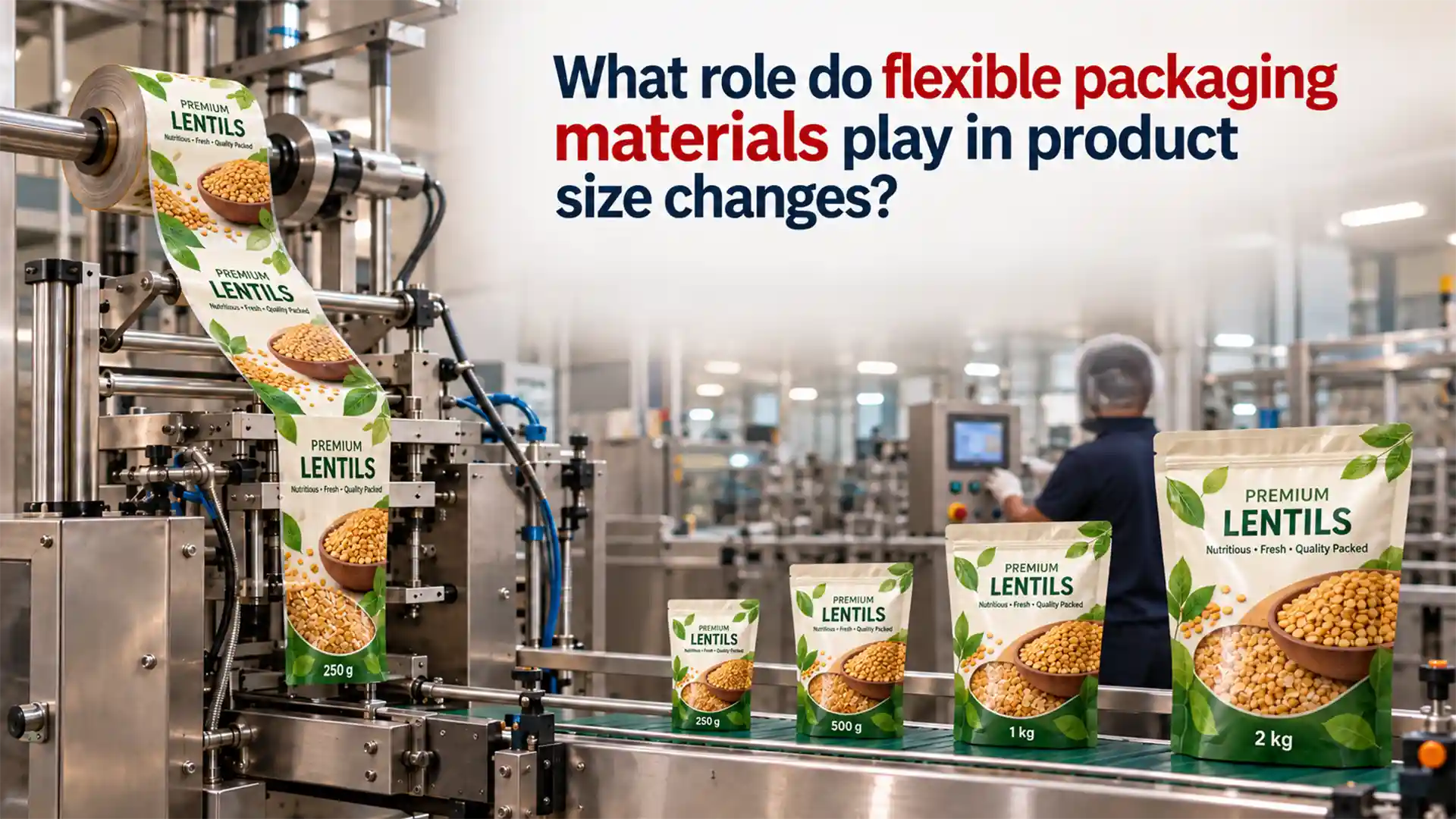
What role do flexible packaging materials play in product size changes?
When a business introduces new product sizes, packaging must change with it. A smaller pack, larger pack or different fill quantity can affect dimensions, sealing, filling speed, storage and transportation. Flexible Packaging Materials offer useful adaptability because packaging structures can be developed in different dimensions while maintaining the functional requirements of the product.
For Ashoka Poly Laminators, packaging development starts with understanding the application. Product size is only one consideration. The filling process, product characteristics, handling conditions and distribution requirements also influence the final packaging format.
Why changing product sizes affects packaging
Changing the quantity inside a package may sound straightforward, but it can affect the complete packaging operation.
A business moving from a 1 kg pack to 500 g or 250 g may need different dimensions to avoid unnecessary empty space. A larger pack may require greater attention to handling and sealing. Even the filling equipment may need adjustments when package dimensions change.
This is why Flexible Packaging Materials can be useful when businesses are expanding or diversifying their product range. Their adaptable format allows packaging specifications to be considered around different quantities rather than forcing every product into one standard size.
One product can require several packaging formats
Many manufacturers eventually offer the same product in multiple quantities.
For example, a product might be available in small packs for individual buyers, medium packs for regular consumption and larger packs for institutional customers. Although the branding can remain consistent, the physical packaging requirements may differ.
Dimensions, sealing areas and material consumption can all change according to the quantity being packed.
APL Products can be considered within this type of packaging planning, where each format is evaluated according to the product and its intended use.
The objective is to create a packaging family that remains consistent without assuming that every size should use exactly the same physical specification.
Start with the product before finalizing dimensions
A common mistake is to decide package dimensions based only on the desired fill weight.
Product density, shape and flow characteristics can influence the amount of space required. Two products with the same weight may occupy different volumes and therefore require different packaging dimensions.
Before finalizing a new size, businesses should consider:
- Product weight and volume
- Product density and physical characteristics
- Filling method
- Required headspace
- Sealing requirements
- Storage conditions
- Transportation arrangements
This product-first approach makes it easier to select Flexible Packaging Materials that are appropriate for the actual application.
Smaller packs create their own requirements
Reducing pack size does not simply mean scaling down every dimension.
A smaller package may need a different balance between usable product space and sealing area. It may also be handled differently by consumers, filling equipment and distribution teams.
For example, a manufacturer introducing a small trial pack may need packaging that is easy to fill, seal and handle while maintaining the same product identity as its larger formats.
Ashoka Poly Laminators can be considered when businesses are reviewing how packaging should adapt as new quantities are introduced.
The important consideration is whether the new format works effectively in the real production environment.
Larger packs need attention to handling
Increasing the package size can create a different set of challenges.
A larger pack generally contains more product and may be subjected to greater handling demands. Its dimensions can also influence how it is stacked, moved and transported.
Businesses should therefore avoid assuming that simply increasing the dimensions of an existing package will provide the right solution.
The new format should be evaluated against the complete workflow, from filling and sealing to warehouse movement and delivery.
Production equipment must be considered
Product-size changes can affect packaging machinery as well.
Different dimensions may influence filling accuracy, forming, sealing alignment or machine settings. If several pack sizes are being produced on the same equipment, production teams may also need to consider changeover time and operating consistency.
For this reason, packaging development should involve both procurement and production teams.
A specification that looks suitable on paper may still create operational problems if it does not fit the existing packaging process.
Branding should remain consistent across sizes
A product range often needs visual consistency even when its packaging formats differ.
Businesses may retain the same brand identity, product information and general design language across multiple sizes while adjusting the artwork to suit each format.
APL Packaging Products can be approached from this perspective, balancing the physical requirements of different pack sizes with the need for consistent product presentation.
The design should also leave sufficient practical space for required information, printing and sealing areas.
Material selection should match the new format
Changing the package size is also an opportunity to review whether the existing material specification remains appropriate.
The product may experience different handling conditions in a larger pack. A smaller pack may require different forming or sealing characteristics. Distribution channels may also differ between product sizes.
For flexible applications, APL Flexible Packaging can be considered as part of a wider review of structure and format.
The goal should not be to increase material specifications automatically. Instead, businesses should identify the characteristics that the new pack actually requires.
When should businesses review their packaging?
A packaging review is useful whenever a company introduces:
- A new fill quantity
- Smaller or larger consumer packs
- New product variants
- A different filling process
- New distribution channels
- Different storage conditions
- Changes in transportation requirements
Early planning can prevent packaging problems from appearing after the product has already entered production.
It also gives procurement teams enough time to evaluate samples, confirm dimensions and coordinate the new specification with manufacturing requirements.
A practical example of a size transition
Consider a manufacturer that traditionally sells a product in a 1 kg package. The company then introduces a 250 g version to reach customers looking for a smaller quantity.
The new package needs more than a simple reduction in dimensions. The manufacturer needs to consider product volume, filling accuracy, sealing space, storage arrangement and the way the smaller pack will be handled.
The artwork may remain recognizable, but the physical specification should be developed around the smaller quantity.
This is where Ashoka Poly Laminators can be part of the packaging discussion, helping businesses approach a new pack size according to its actual application.
What should procurement teams provide?
A packaging supplier can make a more useful recommendation when the business provides detailed information from the beginning.
The brief should ideally include the product type, target fill weight, preferred dimensions, filling method, sealing requirements, expected order volumes, storage conditions and distribution route.
Existing packaging samples can also be useful when a business is modifying an established format.
For companies reviewing APL Packaging Materials, this information helps connect the material specification with the intended product size and operating conditions.
Customization should have a clear purpose
Not every change in product quantity requires completely customized packaging.
If the existing structure performs well across several sizes, it may be possible to adapt dimensions without changing the fundamental material approach. On the other hand, significant changes in product weight, handling or distribution may justify a more detailed packaging review.
The purpose of customization should always be clear.
A useful change might improve filling efficiency, reduce unnecessary space, simplify handling, improve stacking or provide a better fit for the product.
Why Ashoka Poly Laminators?
Packaging development works best when the supplier understands the reason behind the requested change.
Ashoka Poly Laminators can be approached when businesses need to evaluate packaging for different product quantities or are planning to introduce new sizes.
The focus should remain on practical compatibility, material suitability, dimensions and production requirements. A packaging specification should support the product throughout its journey rather than solve only the filling-stage requirement.
Conclusion
Product-size changes can affect nearly every part of the packaging process. Dimensions, filling, sealing, handling, storage, transportation and printing may all need to be reviewed when a business introduces a new pack size.
Flexible Packaging Materials provide useful adaptability for these changes, but the right format still depends on the product and its operating environment.
Businesses planning multiple product sizes should evaluate packaging early and involve procurement, production and packaging teams in the decision.
If you are developing a new product size or reviewing an existing format, Ashoka Poly Laminators can help you discuss the packaging requirements.
Phone: +91 7078666249
Email: apl@ashokafoam.com

Recent Posts

When does packaging need to change as a business moves into new markets?
What role do flexible packaging materials play in product size changes?