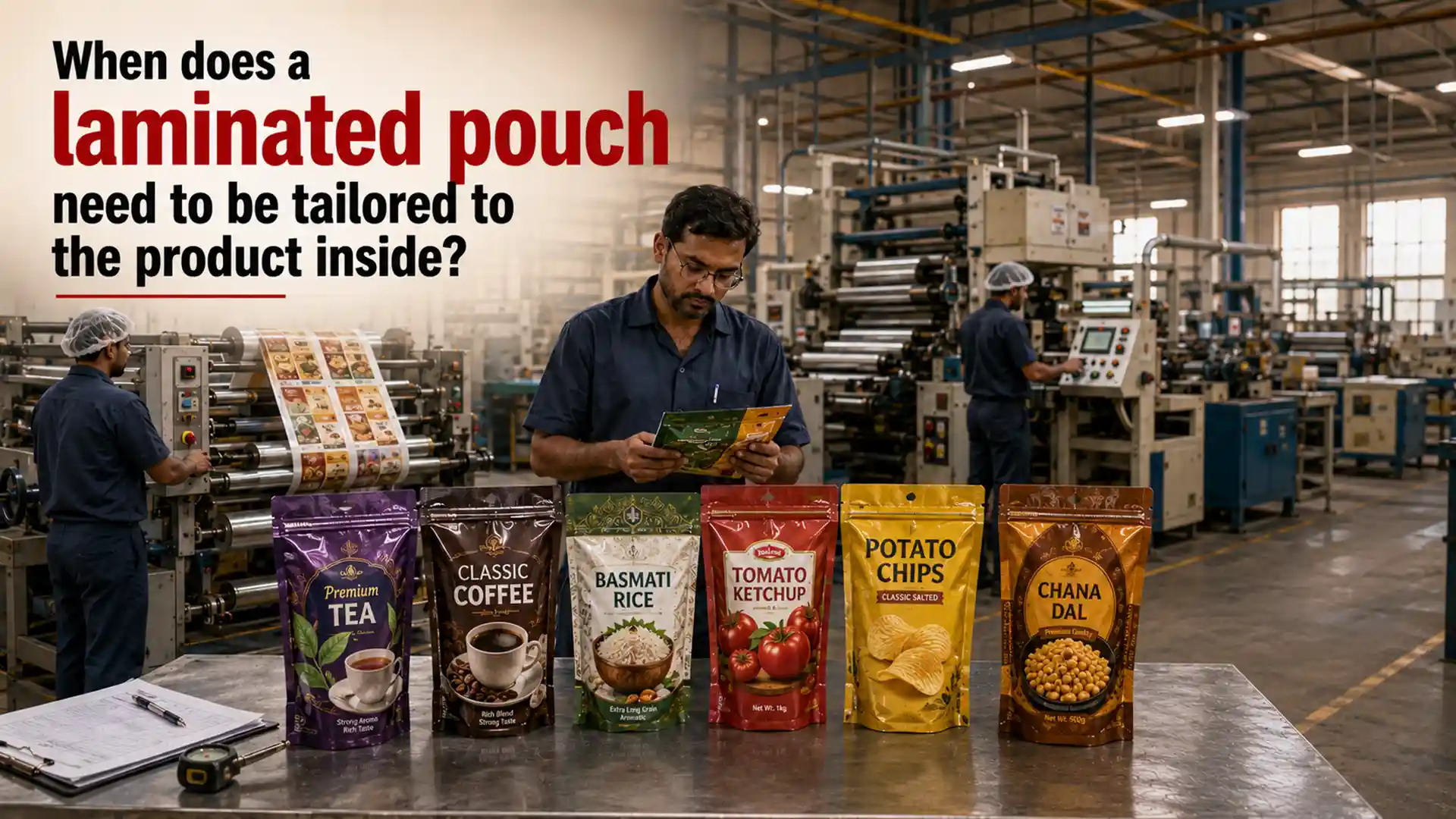
When does a laminated pouch need to be tailored to the product inside?
A pouch should do more than contain a product. Its material structure, dimensions, sealing properties, and barrier performance need to suit what is being packed and how that package will be stored, transported, opened, and used. A pouch that works well for one product may not provide the same performance for another.
This is where Ashoka Poly Laminators approaches pouch development from the product outward. A Laminated Pouch Manufacturer needs to understand the characteristics of the contents before recommending a suitable structure. Moisture sensitivity, product weight, filling method, shelf-life requirements, printing, and handling conditions can all influence the final design.
The need for tailoring becomes particularly clear when standard packaging does not adequately address the product’s actual requirements.
Start with the behaviour of the product
Two products with similar pack sizes can still require very different packaging.
A dry powder, for example, may behave differently during filling and handling from a granular product. A product containing oils or volatile ingredients can create another set of material considerations.
The first step is therefore to understand what is being packed.
Questions around product consistency, sensitivity to external conditions, fill quantity, and intended storage period can help establish which packaging characteristics matter most.
Moisture sensitivity can change the structure
Moisture is an important consideration for many packaged products.
Products that need to remain dry may require a structure that provides suitable resistance against moisture entering the package. This can be particularly relevant for food products, powders, spices, and other moisture-sensitive materials.
The required level of protection depends on the product and its expected environment. A package stored in a controlled indoor facility may face different conditions from one travelling through humid regions.
A Laminated Pouch Manufacturer can consider these conditions when discussing the appropriate material combination rather than treating every pouch application identically.
Product weight influences pouch construction
The contents also determine how much physical stress the package may experience.
A lightweight product may place relatively little load on the pouch, while a heavier fill can create greater stress during lifting, stacking, transportation, and handling.
The pouch dimensions and construction should therefore be considered alongside the intended fill weight.
This is especially important when businesses are moving from smaller packs to larger formats. Simply increasing the quantity without reviewing the packaging specification may not provide the same handling performance.
The filling process matters before the pouch is even sealed
Packaging has to work with the machinery used to fill it.
Pouch dimensions, opening characteristics, material behaviour, and sealing requirements can affect how smoothly the package moves through a filling operation. Automated production lines may have specific requirements that need to be considered during packaging development.
For businesses producing large quantities, compatibility with existing machinery can be just as important as the appearance of the finished pouch.
Ashoka Poly Laminators can discuss these production requirements as part of the packaging specification so that the proposed structure is considered from a manufacturing perspective as well.
Shelf life can influence material selection
The required shelf life is another reason a standard pouch may not always be appropriate.
A product expected to remain on the shelf for an extended period may require different protection from one intended for rapid consumption. The expected storage environment also matters.
Temperature, humidity, light exposure, and distribution conditions can influence how packaging performs over time.
Instead of choosing a structure based only on what is commonly used for a particular product category, packaging teams should establish what protection the product actually requires throughout its expected shelf life.
The opening experience should match the product
A pouch also needs to make sense after it reaches the customer.
Some products are consumed immediately after opening. Others may be used gradually, requiring the package to remain practical between uses.
This can influence decisions around opening style, pouch dimensions, and closure requirements.
For example, a product intended for repeated household use may benefit from a different format from a single-use pack. The packaging should reflect the actual usage pattern rather than adding features without a clear purpose.
Product quantity affects more than size
The amount packed inside a pouch influences its overall dimensions and handling characteristics.
A very small pack may prioritise portability and easy storage. A larger pack may need greater consideration for grip, movement, stacking, and transportation.
The shape of the finished pouch can also affect how efficiently it fits into secondary packaging and how it is arranged during distribution.
This means the required fill quantity should be established early when developing a new pouch format.
Printing requirements should be considered with the structure
Packaging often has an important communication role.
Branding, product information, usage instructions, regulatory details, and other graphics need to appear clearly on the finished package. The intended printing requirements can therefore influence the choice and arrangement of material layers.
A business launching a premium consumer product may have very different visual requirements from an industrial product where clear identification is the primary concern.
At Ashoka Poly Laminators, printing considerations can be discussed alongside material and application requirements instead of being treated as a completely separate decision.
Distribution can reveal hidden packaging requirements
The journey between the factory and final user can be surprisingly demanding.
Pouches may be packed into cartons, stacked, transported over long distances, unloaded, stored, and handled several times. During these stages, the package can experience compression, friction, movement, and changes in environmental conditions.
A product that performs well in a controlled storage environment may need a different approach when it is distributed through a more demanding supply chain.
This is why the intended distribution route should be part of the packaging conversation.
When is standardisation useful?
Not every pouch needs a completely unique structure.
If several products have similar characteristics, a business may be able to standardise certain packaging specifications. This can simplify procurement, production planning, inventory management, and future ordering.
However, standardisation should follow the application rather than replace it.
If two products have substantially different protection or handling requirements, forcing them into the same structure simply for purchasing convenience may create unnecessary packaging problems.
A practical example: dry food products
Consider a packaged spice product.
The packaging may need to protect the contents from moisture, provide a suitable surface for high-quality printing, maintain reliable seals, and remain practical during household use.
Now consider a heavier dry ingredient sold in a larger format. The product may require greater attention to physical handling, pack dimensions, and transportation.
Both products may technically use laminated packaging, but their specifications do not necessarily need to be identical.
That distinction is where product-focused development becomes valuable.
What should buyers tell the manufacturer?
A detailed packaging brief does not have to be complicated.
Before discussing a new pouch specification, buyers should be prepared to share:
- Product type and characteristics
- Required fill quantity
- Desired pouch dimensions
- Filling and sealing method
- Expected shelf life
- Storage conditions
- Distribution environment
- Printing requirements
- Intended usage after opening
These details allow the manufacturer to understand the application instead of working from a product name alone.
Why early manufacturer involvement helps
Bringing the manufacturer into the discussion early can help identify practical considerations before the packaging reaches production.
A Laminated Pouch Manufacturer can evaluate how material selection, pouch dimensions, printing, sealing, and filling requirements interact with one another.
This can be particularly useful when developing a new product, changing pack sizes, moving to automated filling, or experiencing problems with an existing packaging format.
The objective is not simply to manufacture the pouch. It is to establish a specification that makes sense for the product and its operating environment.
Final thoughts
A pouch needs to be tailored when the product places specific demands on protection, handling, filling, sealing, storage, distribution, or user experience. The more specialised those requirements become, the less useful a generic packaging specification may be.
The right approach is to begin with the product and work outward. Once its characteristics and journey are understood, material structure, dimensions, printing, sealing, and other features can be selected with a clear purpose.
Ashoka Poly Laminators works with businesses to understand these requirements before finalising pouch specifications, helping packaging decisions reflect the actual product rather than relying on a one-size-fits-all approach.
Discuss Your Pouch Requirement
If you are developing a new product, changing your pack format, or reviewing an existing pouch, share your product type, fill quantity, Packaging Solution process, and application requirements with Ashoka Poly Laminators.
Phone: +91 7078666249
Email: apl@ashokafoam.com
Request a product-specific pouch discussion for your next packaging requirement.

Recent Posts

Festive dispatches are growing—can your tarpaulin handle the journey?
Festive sweets need more than a pretty pouch—what keeps them protected?