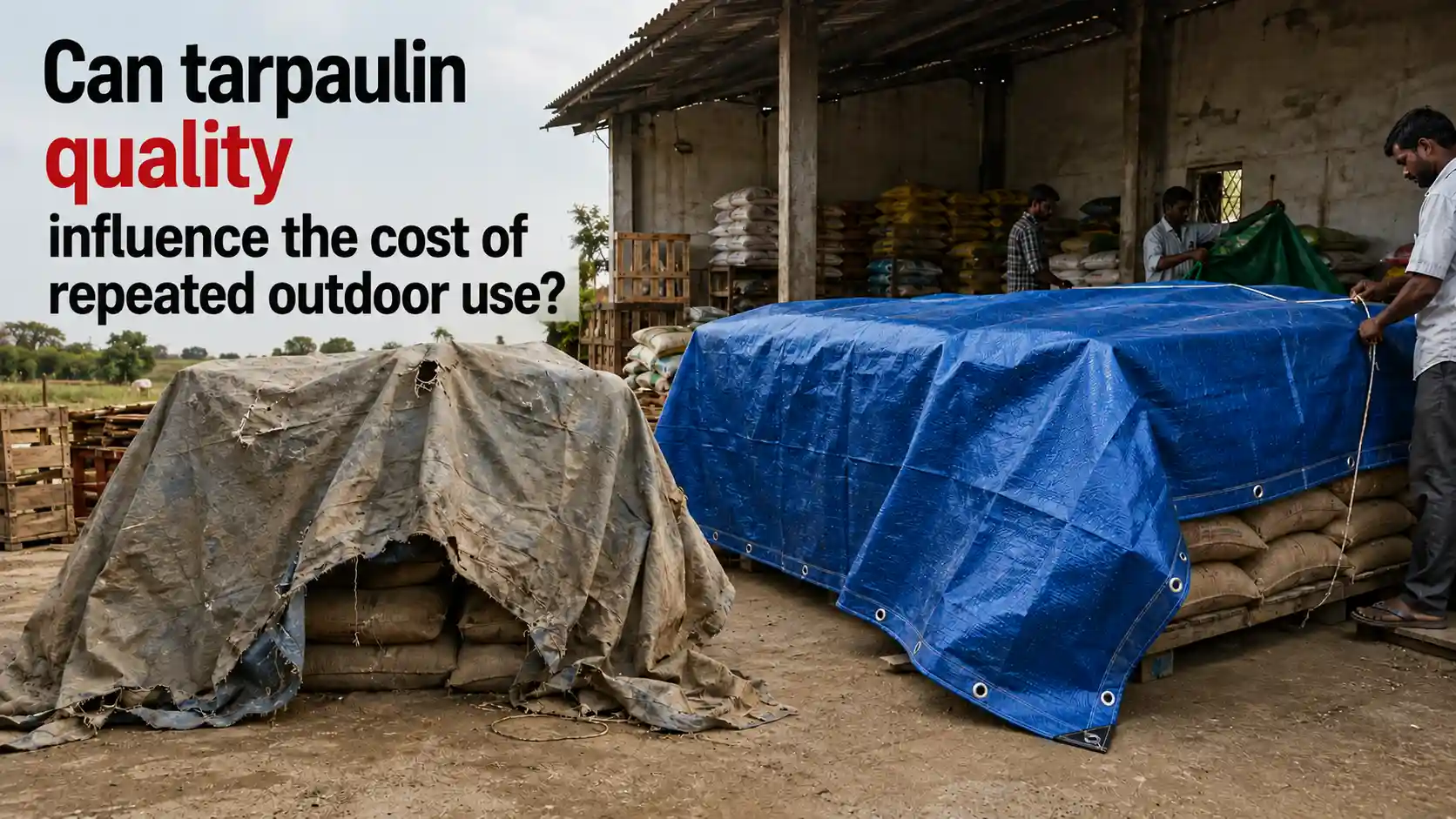
Can tarpaulin quality influence the cost of repeated outdoor use?
The purchase price of a tarpaulin is only one part of its actual cost. When a cover is used repeatedly outdoors, its performance can influence how often it needs to be replaced, how easily it can be handled, and how reliably it protects the material underneath.
Ashoka Poly Laminators understands that outdoor applications can place very different demands on tarpaulin. Agricultural storage, vehicle covering, construction sites, and general material protection can involve exposure to sunlight, rain, dust, wind, folding, tying, and repeated movement. For buyers comparing the Best Tarpaulin Brand in India, looking at long-term use rather than only the initial quotation can provide a more useful picture of value.
The cheapest sheet may not remain the cheapest option
Imagine two businesses purchasing tarpaulin for the same outdoor application.
One selects a product primarily because its initial price is lower. The other compares construction, expected exposure, handling requirements, and suitability before making a decision.
If the first product needs to be replaced more frequently or becomes difficult to use after repeated handling, its original price advantage can gradually disappear.
This does not mean that the most expensive tarpaulin is automatically the best choice. The important point is to compare products according to the work they are expected to perform.
A suitable specification can make the purchasing decision more meaningful than simply selecting the lowest quotation.
Outdoor exposure changes the cost equation
Tarpaulin used outside may experience conditions that are absent from indoor storage.
Sunlight, rain, humidity, dust, wind, and changing temperatures can all become part of everyday use. The longer the cover remains exposed, the more important it becomes to understand whether its construction is appropriate for those conditions.
UV exposure deserves particular attention in applications where the material stays outdoors for extended periods. Agricultural covers, truck tarpaulins, construction protection, and outdoor storage can all involve prolonged exposure.
When evaluating the Best Tarpaulin Brand in India, buyers should therefore ask what environmental conditions the product is intended to handle rather than relying only on broad descriptions such as “heavy duty.”
Construction affects repeated handling
Outdoor covers rarely remain untouched.
They are pulled into position, tied down, removed, folded, transported, and installed again. Corners and fastening areas can receive considerable handling during these activities.
A tarpaulin intended for repeated use therefore needs to be considered as a finished product rather than simply as a sheet of material.
Fabric construction, coating, stitching, dimensions, and fastening points can all contribute to how practical the cover is during repeated use.
For Ashoka Poly Laminators, understanding how customers handle the product is an important part of discussing the appropriate tarpaulin requirement.
Eyelets can influence everyday usability
Fastening points may seem like a small detail, but they become important when a cover has to be secured repeatedly.
Truck operators may tie and untie covers during loading. Agricultural users may secure covers over stored materials. Construction teams may reposition protective sheets as work progresses.
These activities can place repeated pressure around eyelets and corners.
Buyers should therefore consider how frequently the tarpaulin will be secured and released. A specification that works for occasional use may not necessarily provide the same practical value for an application involving constant handling.
Replacement frequency is an important hidden cost
The cost of a tarpaulin does not end with the purchase invoice.
If a business has to replace covers frequently, procurement teams also spend time arranging new orders, checking stock, managing disposal, and replacing products that are no longer suitable for use.
There can also be operational consequences if a replacement is required unexpectedly.
For businesses using large quantities of outdoor covers, these indirect costs can become significant over time. A product that remains suitable for longer under the intended conditions may therefore offer better overall value, even if its initial purchase price is not the lowest.
Different applications create different cost pressures
The meaning of “long-term use” varies between industries.
A farmer may use a cover throughout an agricultural season. A transport company may handle the same type of tarpaulin repeatedly as vehicles are loaded and unloaded. A construction business may move protective covers around a site as different activities take place.
These applications expose the material to different stresses.
For example, a vehicle cover may experience more frequent folding and tying, while an agricultural cover may spend longer periods exposed to weather. A construction cover may be repositioned frequently.
This is why a Tarpaulin Manufacturer needs to understand the application before a buyer decides which specification offers the best value.
Weight alone does not tell the complete story
GSM is often considered when buyers compare tarpaulin, and it can be a useful specification.
However, weight by itself does not explain how a finished product will perform in every application. Fabric construction, coating, finishing, dimensions, and intended use also matter.
Choosing a heavier product simply because it has a higher GSM may not provide the expected benefit if the specification does not suit the actual application.
The more useful approach is to consider the complete construction and then determine whether it matches the operating conditions.
Size can affect handling costs too
Incorrect dimensions can create practical problems that are easy to overlook during purchasing.
An undersized cover may need excessive stretching to provide adequate coverage. An oversized sheet can create additional folds, loose sections, and more material to manage during installation and storage.
These issues may seem minor, but repeated across a large fleet, warehouse, farm, or construction operation, they can affect everyday efficiency.
Selecting the correct dimensions from the beginning can make installation, removal, folding, and storage more manageable.
Consider a truck-covering application
Transport provides a useful example of how quality and cost can be connected.
A truck tarpaulin may be installed before departure, secured against movement, exposed to changing weather during the journey, removed during unloading, folded, stored, and used again for another shipment.
The cover is therefore subjected to repeated physical handling as well as outdoor exposure.
If the selected specification is unsuitable for this routine, the business may experience frequent replacements or operational inconvenience. For fleet operators, evaluating the Best Tarpaulin Brand in India should therefore involve looking at actual usage frequency and handling conditions.
Agricultural use has a different pattern
Agricultural applications can present another set of requirements.
A cover may be used to protect stored materials from rain, dust, and sunlight. Depending on the operation, it may remain in position for an extended period before being removed, folded, and stored for future use.
The purchasing decision should account for this seasonal pattern.
A farmer or agricultural distributor may benefit from establishing standard sizes and specifications for recurring applications, making future procurement easier and allowing products to be compared against a consistent requirement.
Double Kissan Tarpaulin can also be evaluated within this application-focused framework, where the intended use and environmental conditions guide the purchasing decision.
Long-term value begins with the right specification
Quality should not be viewed independently from application.
A product that is unnecessarily over-specified can increase the purchase cost without delivering meaningful additional value. On the other hand, a specification that is too basic for demanding outdoor conditions may result in more frequent replacement.
The objective is to find the appropriate balance.
Buyers should first establish where the tarpaulin will be used, how frequently it will be handled, how long it will remain outdoors, and what it needs to protect. Those answers can then guide the required construction.
This makes the discussion with a manufacturer much more productive.
What should buyers ask before ordering?
A practical purchasing discussion can focus on a few important questions:
- How long will the tarpaulin typically remain outdoors?
- Will it be exposed to strong sunlight or frequent rain?
- How often will it be folded, tied, removed, or repositioned?
- What size is required for the application?
- How will the cover be secured?
- Is the product intended for agriculture, transportation, construction, or storage?
- What quantity will be required for regular use?
These questions help buyers evaluate the product based on actual operating conditions rather than a generic quality label.
Why manufacturer input can reduce uncertainty
A manufacturer sees tarpaulin requirements from a production perspective that buyers may not always have.
By discussing the application, the manufacturer can better understand the expected dimensions, construction requirements, environmental exposure, fastening arrangements, and handling pattern.
Ashoka Poly Laminators can use this information when discussing tarpaulin requirements with customers, helping move the conversation from a simple price comparison toward a more appropriate specification.
For recurring orders, maintaining a clear specification can also make future purchasing more consistent.
Final thoughts
The long-term cost of outdoor tarpaulin depends on more than its initial purchase price. Exposure, construction, dimensions, fastening, handling frequency, storage, and application can all influence how practical and economical a cover becomes over repeated use.
For buyers comparing the Best Tarpaulin Brand in India, the better approach is to evaluate the product against the conditions it will actually face. A specification that is appropriate for agriculture may differ from one required for transportation or construction.
At Ashoka Poly Laminators, application requirements can be discussed before finalising the tarpaulin specification, helping businesses consider performance and long-term value together.
Contact Ashoka Poly Laminators
If you require tarpaulin for agriculture, transportation, construction, storage, or repeated outdoor use, share your application, dimensions, quantity, and expected exposure with Ashoka Poly Laminators.
Phone: +91 7078666249
Email: apl@ashokafoam.com
Discuss your requirement and request a suitable bulk-order specification.

Recent Posts
Festive dispatches are growing—can your tarpaulin handle the journey?

Festive sweets need more than a pretty pouch—what keeps them protected?