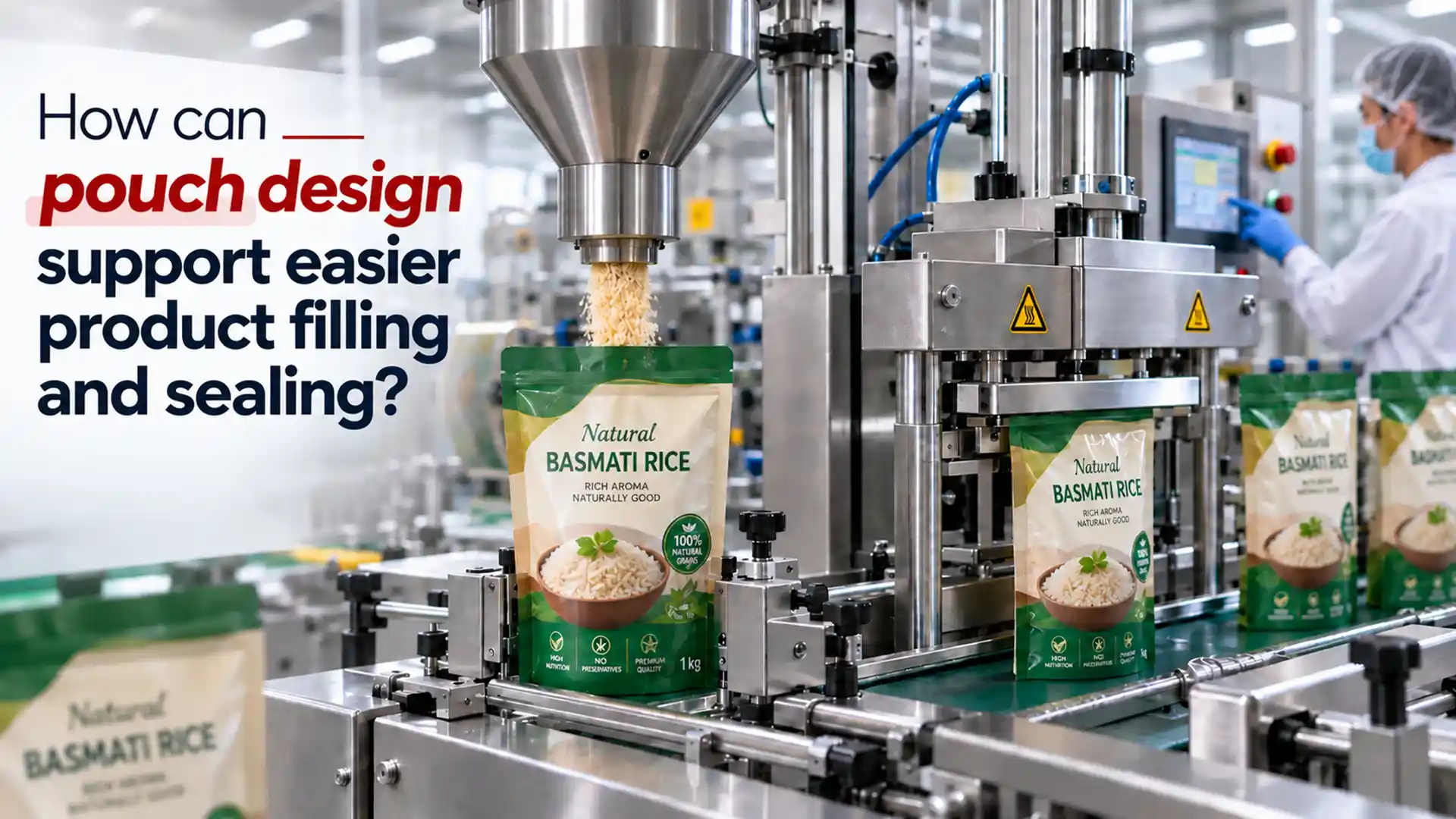
How can pouch design support easier product filling and sealing?
A pouch may look simple once it reaches the shelf, but its design can directly affect what happens during production. Packaging Pouch Manufacturers need to consider how a pouch opens, receives the product, stays positioned during filling, and moves through the sealing stage. A design that looks attractive but performs poorly on the filling line can create unnecessary interruptions and inconsistent seals.
Ashoka Poly Laminators considers pouch construction as part of the wider packaging process. Dimensions, material structure, opening area, sealing zone, and the product itself all influence whether a pouch is practical to fill and seal.
The goal is not simply to create a pouch that holds the product. It is to create a format that works smoothly from filling through final sealing.
Start with how the product enters the pouch
The filling process should influence the pouch design from the beginning.
Powders, granules, snacks, spices, and other products can behave differently during filling. Some flow easily, while others may bridge, settle unevenly, or create dust around the opening.
The pouch therefore needs an opening and structure that work with the filling method being used.
For automated lines, consistency becomes especially important. If the pouch does not remain properly positioned or the opening is difficult to access, the filling operation can become less predictable.
Pouch dimensions affect machine handling
A change in pouch width or height can influence how the package moves through production.
The dimensions need to work with the filling equipment, gripping arrangements, sealing jaws, and product quantity. A pouch that is too narrow may make filling difficult, while excessive dimensions can create unnecessary material use or handling space.
This is why Packaging Pouch Manufacturers should understand the filling equipment before finalising the format.
At Ashoka Poly Laminators, pouch requirements can be discussed around the intended product quantity and packaging process rather than treating dimensions as an isolated design decision.
The opening needs enough working space
Filling becomes easier when the product has a clear path into the pouch.
The opening should provide sufficient working space for the filling process while leaving an appropriate area for the final seal. If product material reaches the sealing zone, it can interfere with seal formation.
This is particularly relevant for fine powders and products that may leave particles around the mouth of the pouch.
A practical design therefore separates the filling area from the sealing area as much as possible.
The sealing area deserves early attention
The seal is one of the most important functional parts of the pouch.
A reliable seal depends on factors including the material structure, sealing temperature, pressure, dwell time, equipment settings, and cleanliness of the sealing area.
Pouch design can support this process by providing a suitable and consistent seal zone.
A wider package does not automatically need a wider seal, and a smaller package does not necessarily require the same sealing arrangement. The final construction needs to work with the equipment and material combination.
Material selection affects sealing behaviour
Pouch design is not only about shape.
The layers used in a flexible structure can influence heat-sealing behaviour, barrier performance, stiffness, printability, and overall package performance.
The appropriate structure depends on the product.
For example, a food product that requires protection against moisture or oxygen may need a different material combination from a dry industrial product with simpler requirements.
Ashoka Poly Laminators can evaluate the intended application when discussing flexible pouch structures, helping connect material selection with the filling and sealing process.
Product weight can change the design requirement
A pouch carrying a small quantity may experience very different stresses from one carrying a substantially larger quantity.
The filled weight can influence the required material construction, seal configuration, dimensions, and handling method.
This is why a successful pouch design should begin with a clear understanding of the product quantity rather than simply scaling an existing design up or down.
For businesses offering multiple pack sizes, each format can be reviewed according to its actual filling and handling requirements.
Keep the printed area away from critical seals
Printing and sealing need to work together.
Important graphics, product information, and branding should be positioned so they remain readable while allowing the sealing area to perform its intended function.
Poor artwork placement can also create production complications if printed areas extend into sections that need to remain clean for sealing.
A coordinated design process helps ensure that the visual and functional elements of the pouch support one another.
Shape can influence filling efficiency
Pouches are not all designed in the same format.
Depending on the application, a pouch may be developed with different widths, heights, gussets, closures, or opening arrangements. These features can affect how the package stands, opens, fills, and seals.
For example, a pouch intended to stand on a retail shelf may require a different construction from a format designed primarily for efficient filling and compact storage.
The best shape is therefore determined by the complete application rather than appearance alone.
Avoid designing around appearance first
A visually impressive pouch can still create problems on the production line.
If the format is difficult to open, unstable during filling, or leaves insufficient space for sealing, its appearance offers little operational benefit.
Packaging development works better when functional requirements are established first. Once the dimensions, material structure, opening, and sealing requirements are clear, visual design can be developed around them.
This approach can help businesses avoid expensive changes after artwork or production tooling has already been prepared.
A simple example: powdered products
Consider a powdered food product being packed into individual pouches.
The powder needs to enter the package efficiently, while the upper sealing area must remain as clean as possible. If powder accumulates around the seal, the sealing process may become less consistent.
A suitable pouch design can provide enough filling space while maintaining a defined sealing area.
The result is not simply a better-looking package. It is a format that better supports the actual production sequence.
What should be tested before full production?
A pouch should ideally be evaluated under real or representative production conditions before a large-scale run.
Useful checks include:
- How easily the pouch opens
- Whether the filling equipment handles it consistently
- Whether the product reaches the intended fill level
- Whether the sealing area remains sufficiently clean
- Whether the seal performs consistently
- Whether filled pouches can be handled without difficulty
- Whether the printed design remains properly positioned
These checks can identify problems while changes are still manageable.
Why manufacturer involvement can improve the design
The earlier the packaging manufacturer understands the production process, the easier it becomes to align pouch construction with filling and sealing requirements.
Packaging Pouch Manufacturers can contribute more effectively when they know the product, fill weight, machine type, desired dimensions, sealing method, and expected production volume.
At Ashoka Poly Laminators, these practical factors can form part of the packaging discussion before the pouch specification is finalised.
That can reduce the risk of designing a pouch that works well visually but creates avoidable production challenges.
When multiple sizes are required
Many product ranges need several pouch sizes.
A small pack, regular pack, and larger pack may share a common visual identity while requiring different dimensions and material quantities.
The packaging team should determine whether the same material structure and production approach can be adapted across these formats. In some cases, it can simplify procurement and product-line management. In others, the size difference may justify a separate construction.
The decision should be based on actual filling and sealing performance.
Final thoughts
Good pouch design begins long before the package reaches the filling machine.
Dimensions, opening size, material structure, product weight, artwork placement, and sealing zones all influence how smoothly the package can be filled and closed. When these factors are considered together, the pouch becomes part of an efficient production process rather than simply a container.
Businesses working with Packaging Pouch Manufacturers should therefore explain how the product will be filled and sealed before finalising the design.
Ashoka Poly Laminators can help businesses evaluate pouch requirements around product characteristics, dimensions, material structure, and production needs.
Discuss your pouch packaging requirement
Share your product type, fill quantity, pouch size, filling method, sealing process, and expected order volume with Ashoka Poly Laminators.
Contact Ashoka Poly Laminators
📞 Phone: +91 7078666249
📧 Email: apl@ashokafoam.com
Request a Pouch Packaging specification designed around your filling and sealing process.

Recent Posts

Can BOPP bags make product identification easier across busy warehouses?
How can pouch design support easier product filling and sealing?