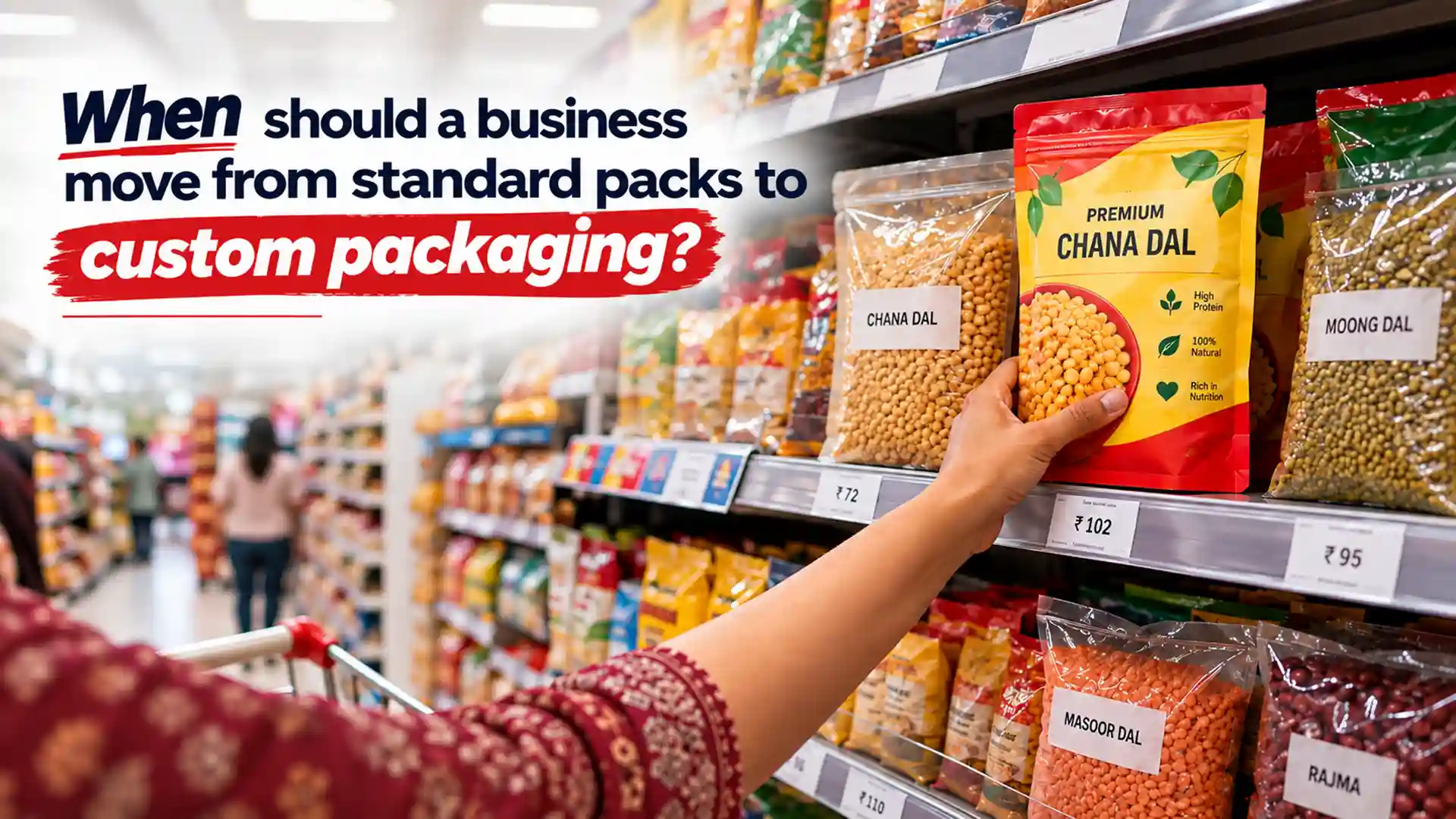
When should a business move from standard packs to custom packaging?
Standard packaging is often enough when a business has simple products, predictable volumes and straightforward handling requirements. But as operations grow, the same pack may start creating problems with fit, filling, storage, transportation or presentation. A Packaging Manufacturer can help businesses determine whether customization would solve these issues and deliver better overall packaging performance.
For Ashoka Poly Laminators, the starting point is the application. Custom packaging should not be introduced simply because it is available. It should address a genuine requirement and make the packaging process more practical.
When does standard packaging become a limitation?
A standard pack can work reliably for years when its dimensions and material suit the product. Problems generally appear when the product or production process changes.
A business may notice excessive empty space, difficult filling, inconsistent stacking or frequent adjustments during packing. These small inefficiencies can become significant when repeated across large production volumes.
This is often a good reason to review the existing format with a Packaging Manufacturer rather than continuing with the same specification automatically.
Customization may be as simple as changing the dimensions or adjusting the construction. It does not always require a completely new packaging concept.
Product growth can change packaging needs
Business growth often changes packaging requirements.
A company may begin with one product size and later introduce multiple variants. It may also move from small orders to regular bulk supply. A standard pack that was suitable at the beginning may then become inefficient.
For example, using one oversized format for several products can create unused space and make stacking less efficient. Separate dimensions may provide a better fit and make handling more consistent.
At this stage, APL Products can be considered according to the specific requirements of the product range. The objective should be to select packaging that supports the way products are actually filled, stored and transported.
Look beyond the filling stage
Packaging performance should be evaluated throughout the supply chain.
After filling, packs may be stacked, moved manually, loaded onto vehicles and stored for extended periods. If the existing format repeatedly tears, deforms, leaks or becomes difficult to handle, the specification deserves closer attention.
Businesses should consider:
- Product weight and characteristics
- Filling and sealing methods
- Stacking requirements
- Handling frequency
- Storage conditions
- Transportation distance
- Exposure to moisture and environmental conditions
These factors help identify whether the current format is genuinely suitable or whether a customized solution could provide better performance.
Branding can also trigger a packaging change
Packaging is not always purely functional. For many products, it is also an important identification and presentation tool.
As a product range expands, businesses may need clearer differentiation between sizes, grades or variants. Consistent printing and appropriate artwork can make products easier to identify during distribution and storage.
APL Packaging Products can therefore be evaluated from both functional and presentation perspectives. The objective is to create packaging that protects the product while supporting clear identification.
However, branding should remain practical. Adding unnecessary design elements or specifications can increase complexity without creating a meaningful benefit.
Storage and transportation deserve attention
One of the most overlooked areas in packaging decisions is what happens after production.
A standard pack may have a reasonable purchase price but still create problems if its dimensions result in poor stacking or excessive unused space. Inefficient pack sizes can affect warehouse organization and transportation utilization.
A better approach is to assess the complete packaging journey:
Filling → sealing → handling → stacking → storage → transportation
If the same packaging problem appears repeatedly across these stages, customization may offer a stronger business case.
This application-led approach is central to developing practical APL Packaging Solutions, where packaging decisions are connected to actual operational requirements.
When should the material be reconsidered?
Sometimes dimensions are not the main problem. The material structure itself may need review.
Different products can require different combinations of flexibility, strength, sealing performance, printability or barrier characteristics. For flexible applications, selecting an appropriate structure can influence how the package performs during filling, handling and storage.
APL Flexible Packaging can be considered when businesses need packaging structures that align with specific flexible-packaging requirements.
The important point is to select material characteristics for a reason. A more complex specification is not necessarily a better specification.
Six questions before choosing custom packaging
Before changing from a standard format, businesses can ask:
Is the current pack causing recurring problems?
Frequent tearing, poor fit, sealing difficulties or handling issues may justify a review.
Has the product range expanded?
Multiple product sizes may require more appropriate packaging dimensions.
Are production volumes becoming consistent?
Stable volumes can make customization more practical.
Is storage space being used efficiently?
Poorly sized packs can affect stacking and warehouse organization.
Has the distribution model changed?
Longer transportation distances or more frequent handling can create new packaging demands.
Does the product need stronger identification?
Growing product lines may benefit from clearer and more consistent packaging presentation.
When several answers point toward limitations, it is worth discussing alternatives with a packaging specialist.
Give your packaging partner the right information
A useful packaging discussion begins with accurate application details.
Businesses should provide information about the product, pack weight, approximate dimensions, filling process, sealing method, storage environment, transportation conditions and expected volumes.
A sample of the existing package can also help identify where changes may be useful.
For industrial applications, APL Industrial Packaging should be assessed around the complete workflow rather than treating the package as an isolated purchase.
The aim is to create a specification that works in production and remains practical during distribution.
Customization should create measurable value
Custom packaging makes sense when it solves a real business problem.
The improvement might come from better product protection, easier filling, improved stacking, clearer product identification or smoother handling. In some cases, several small gains can collectively justify the change.
This is why APL Packaging Materials should be selected according to the application’s requirements rather than simply choosing the most readily available specification.
Businesses should also compare the wider cost of packaging. A slightly different unit price may be worthwhile if the new format reduces handling difficulties, product damage or inefficient use of storage and transport space.
Why choose Ashoka Poly Laminators?
A packaging partner should understand the practical conditions surrounding a product.
Ashoka Poly Laminators can be approached when businesses want to review whether their existing standard packaging remains appropriate or whether customization could better support their application.
The right solution should balance performance, practicality, presentation and commercial considerations. Customization is valuable when it improves the packaging system—not merely because a customized format can be produced.
Conclusion: customize when the standard format no longer fits
The move from standard to custom packaging should be based on business requirements rather than trends. Product growth, changing production methods, handling issues, storage limitations, transportation challenges and branding needs can all indicate that the existing format deserves a review.
If your current packaging repeatedly creates compromises, discussing the application with a Packaging Manufacturer can help identify whether customization is justified.
Need help reviewing your packaging requirement? Contact Ashoka Poly Laminators.
Phone: +91 7078666249
Email:apl@ashokafoam.com

Recent Posts

When does packaging need to change as a business moves into new markets?
What role do flexible packaging materials play in product size changes?